
The complete guide
Beyond Emotional Awareness: The Guide to All 131 Feelings on the Wheel
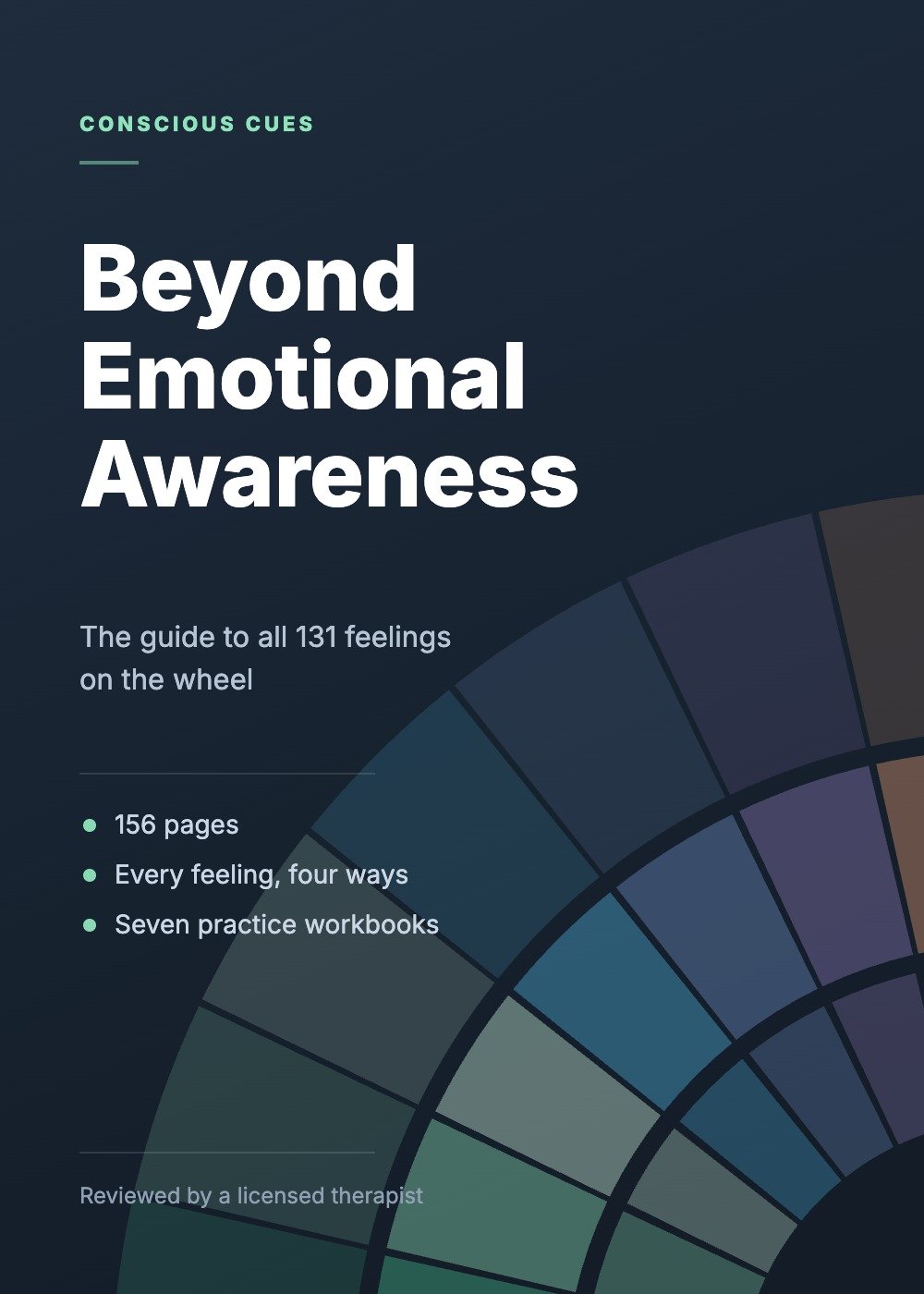
A 156-page reference for what to do once you have the word. Every feeling on the wheel, broken down four ways, plus seven practice workbooks.

Inside Beyond Emotional Awareness
156 pages. All 131 feelings from the wheel, each broken down four ways: what the brain and body are doing, what the feeling is protecting, where it sits somatically, and one thing to try. Plus seven practice workbooks, body maps, a locator page for when you cannot name it yet, and a clickable index.
$29.99 $49
Already bought it?
Enter the email you used at checkout and we will send you a six digit code. It unlocks the download on this device for 30 days.
Your download is unlocked
Saved on this device for 30 days. Come back any time.
What this guide is
The feelings wheel gives you a word. This guide tells you what to do once you have it. It is a 156-page reference covering all 131 feelings on the wheel, and it exists because naming a feeling accurately is only useful if something follows from the naming.
Every entry is laid out the same way, so you always know where to look:
- Neuroscientifically. What the brain and body are actually doing, in plain language.
- Psychologically. What the feeling is usually protecting, avoiding or asking for.
- Somatically. Where it tends to sit in the body, and what that feels like from the inside.
- Try this. One thing to do, specific enough to do today.
It is a vocabulary, not a diagnosis. Nothing in it names what is wrong with you.
What is inside
- All 131 feelings from the wheel, each with the four-part breakdown
- Seven practice workbooks, one per emotion family
- Body maps showing where each feeling tends to register
- A locator page for when you cannot name it yet
- A clickable index and full bookmarks, so it works as a reference rather than a read-through
- 156 pages, print-ready, yours to keep
The practice pages
Reading about a feeling changes very little on its own. The back half of the guide is seven workbooks, one for each family on the wheel, built around what that family actually needs.
Fear needs the body told, credibly, that the threat is not present now, so it gets a breathing protocol rather than an argument. Anger needs the energy discharged before the boundary is named, because doing it in the other order produces sentences you apologize for. Sadness asks for contact, not correction. Bad is a placeholder for something not yet identified, so it gets a narrowing exercise. Each family gets an exercise with its steps, five journal prompts, four affirmations, a short meditation and a worksheet with room to write.
Who it is for
People who already know that “fine” and “stressed” are not covering it, and who want the more precise word plus something to do with it. It is also built to be used with clients: the four-part structure gives a session a shape, and the worksheets give someone something concrete to take away.
It is not therapy, and it is not a substitute for it. If something in here opens up more than you expected, that is worth taking to a person rather than a PDF.
What the research does and does not say
The underlying claim is affect labeling: putting a feeling into words reduces its intensity. That is one of the better-supported findings in the area, and the guide cites the primary sources rather than asserting it. The related idea, emotional granularity, links being able to tell “disappointed” from “let down” to steadier regulation under stress.
Two honest limits, both stated inside the guide. Much of the granularity research is correlational, so it is entirely possible that people who regulate well develop finer vocabulary rather than the reverse. And the wheel itself, with these seven families in this arrangement, has no evidence base of its own. Gloria Willcox published the format in 1982 as a clinical aid, not as a validated instrument. What is supported is precise naming. The wheel is one convenient route to it.
FAQs
How is this different from the free feelings wheel?
The interactive wheel and the printable list of 91 feelings give you the vocabulary, free. This guide is what sits underneath each word: what is happening in the body, what the feeling is protecting, and what to do about it, for all 131 of them.
Is it a PDF or a physical book?
A PDF, 156 pages, formatted for both screen and print. It has bookmarks and a clickable index, so on a screen you can jump straight to a feeling instead of scrolling.
Can I use it with clients?
Yes. The four-part structure gives a session a repeatable shape, and the practice pages give clients something to take away. The research section states its own limits plainly, which matters if you are handing it to someone who reads citations.
What if I already bought it?
Your copy is still yours, and the practice pages were added at no extra cost. If you bought before that update and have not received the new version, get in touch and we will send it.
Do I need the wheel to use it?
No, though they work well together. Keep the wheel open to find the word, then look it up here.

The Feelings Wheel | List of Feelings – Understanding Your Emotional Intelligence
Feelings Wheel Activities: A Four-Week Workbook You Can Print
List of Feelings: 91 Words for What You’re Actually Feeling (Free PDF)
Boundaries Worksheet PDF — Six Types, Scripts and a Hold Line
New to Conscious Cues? We help you decode your patterns and regulate your nervous system, so you can respond instead of react. We combine neuroscience, psychology, and somatic tools, reviewed by licensed therapists.

Neuro-Somatic Educator • Founder, Conscious Cues
Jordan Buchan is the founder of Conscious Cues and a Neuro-Somatic Educator whose work focuses on the process of turning insight into lived experience. She helps people move beyond simply understanding themselves and into embodying real change so what they know begins to shape how they feel, respond, and live.