
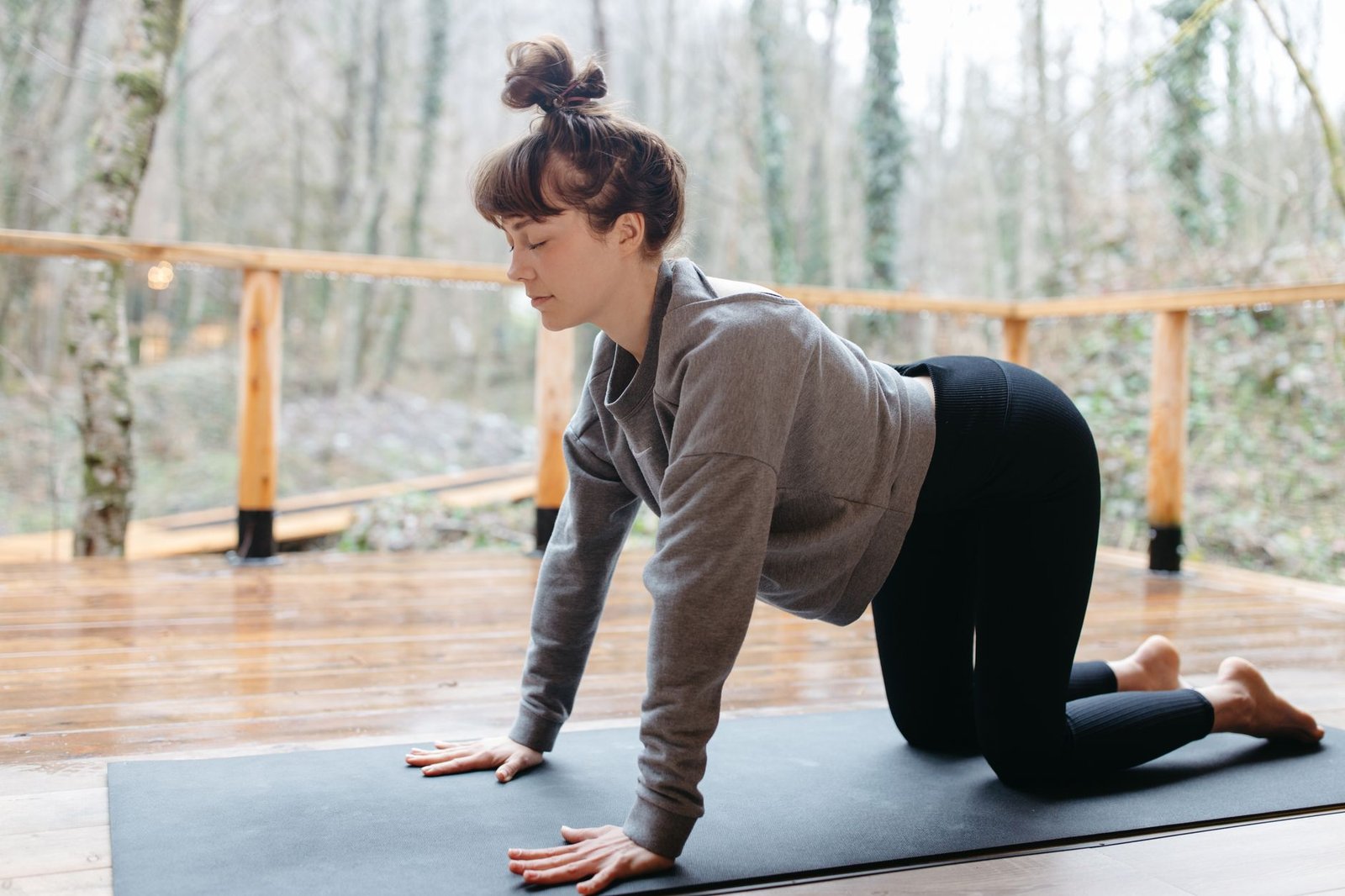
Your back pain is often a “software” issue, not a “hardware” issue. These 5 somatic exercises retrain your brain to release the chronic muscular “grip” it uses to protect you. Move slowly, breathe deeply, and feel the change from the inside out.
Explore the Resource Center
Browse our full library of free worksheets, meditation scripts, and PDF guides. Visit the Resource Center →
The 5 Movements for Back Relief
1. The Arch & Flatten (Vertical Reset)
This targets the “Green Light Reflex”, the state of being constantly “on” that causes the lower back to over-arch and tighten.
- Lie on your back, knees bent, feet flat. Let your arms rest at your sides.
- Inhale: Gently tilt your pelvis forward, creating a small arch in your lower back. Feel the back muscles contract.
- The Peak: Hold that small squeeze for 2 seconds. Feel the effort.
- The Release: Exhale and take 15 seconds to slowly flatten your back against the floor. Imagine your spine is unrolling like a carpet.
- The Flatten: Gently press your lower back into the ground. Feel your belly muscles support the back.
2. The Diagonal Ribbon Release
Tension travels in an “X” across the body. This clearing movement releases the line between your shoulder and opposite hip.
- Lie on your back. Interlace your fingers behind your head. Straighten your left leg, keep the right knee bent.
- Inhale: Gently lift your right elbow and left shoulder just an inch toward the opposite hip.
- The Descent: Spend 20 seconds lowering back down. Feel the diagonal line across your torso getting longer and softer with every millimeter.
3. The Pelvic Clock (Neurological Mapping)
This exercise builds a detailed map of your spine in your brain, turning clunky, stiff movement into fluid motion.
- Imagine a clock face under your tailbone. 12 is your navel, 6 is your tailbone, 3 and 9 are your hips.
- Slowly roll your weight to 12, then move through 1, 2, and 3 (the right hip).
- Continue all the way around the circle. Move so slowly that you feel every tiny shift in pressure.
4. Side-Waist Smoothing
This targets the deep side-back muscles (QL) that cause your hip to “hike” and pinch your spinal discs.
- Lie on your side with knees tucked. Rest your head on your arm.
- Lift your top foot toward the ceiling while keeping your knees together. Feel your waist “pinch.”
- The Melting: Lower the foot as slowly as possible. Take 15 seconds to feel the space between your ribs and hip expand.
5. The Spiral Wash-Rag
Rotation is how the spine decompresses. This movement “wrings out” the tiny rotators between each vertebra.
- Lie on your back, arms out in a “T”.
- Let your knees fall to the right while turning your head to look toward your left hand.
- Breathe into your side. As you bring your knees back, don’t “pull.” Imagine they are floating back to center like they are filled with helium.
The Emotional Connection
Reflective Journaling
“Who am I trying to be ‘the strong one’ for today?” “What weight am I carrying that isn’t actually mine to hold?” “If I let the floor hold 100% of my weight, what am I afraid would happen?” “Where in my life am I refusing to bend out of fear of breaking?”Frequently Asked Questions
Can somatic exercises really relieve back pain?
Yes. Somatic exercises for back pain target the chronic muscle guarding and tension patterns the nervous system holds, often after an old injury or ongoing stress, which can ease pain that stretching or strength work alone doesn’t touch.
What’s the difference between somatic exercises and physical therapy for back pain?
Physical therapy typically focuses on strengthening, alignment, and mechanical correction. Somatic exercises focus on retraining the nervous system’s relationship to movement and tension, and the two approaches work well together.
How long before somatic exercises help chronic back pain?
Many people notice reduced tension within the first few sessions, but retraining deeply held holding patterns in the back usually takes several weeks of consistent, gentle practice.
Is it safe to do somatic exercises with a herniated disc or existing back injury?
Gentle somatic movement is often safe and even helpful, but always check with your doctor or physical therapist first if you have a diagnosed injury, since some techniques may need to be adapted.
Are these somatic exercises useful for neck pain too, or just back pain?
Many of the same principles apply, but for targeted relief, see our dedicated guide on somatic exercises for neck pain.
Related resources

The Best Somatic Exercises for Neck Pain

Does Chronic Pain Make You Tired? Link Between Chronic Pain and Fatigue and How to Improve it

What Is Somatic Yoga? A Nervous System-Guided Way to Move

What Does Somatic Mean?

Neuro-Somatic Educator • Founder, Conscious Cues
Jordan Buchan is the founder of Conscious Cues and a Neuro-Somatic Educator whose work focuses on the process of turning insight into lived experience. She helps people move beyond simply understanding themselves and into embodying real change so what they know begins to shape how they feel, respond, and live.

Psychologist • Certified Kundalini Yoga Instructor
Manuel Alejandro Patiño is a psychologist and certified Kundalini yoga instructor who works where clinical psychology, somatic practice and contemplative tradition meet. He is a certified practitioner of heart-rate variability biofeedback and pulse analysis. He reviews Conscious Cues resources for clinical accuracy.