
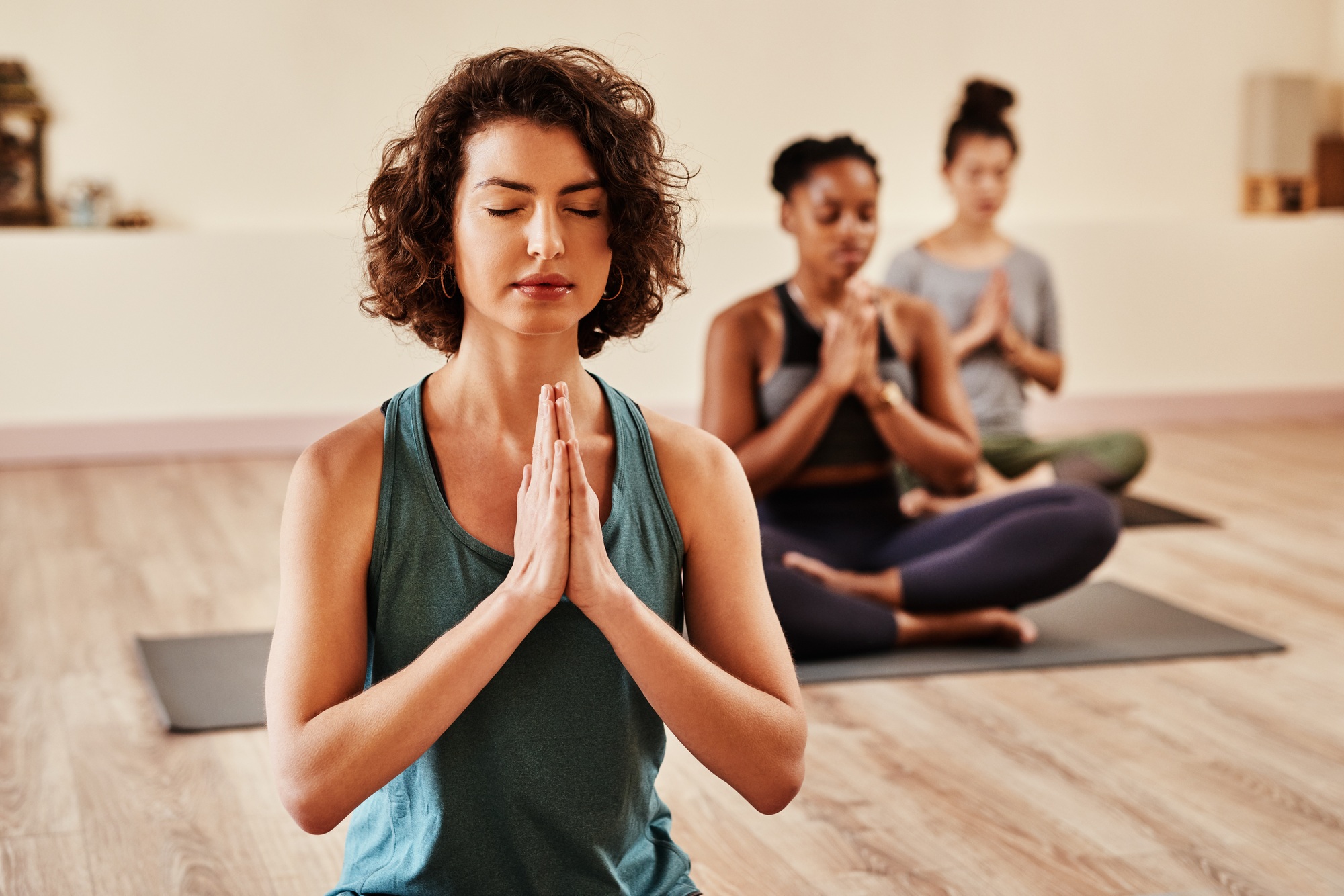
Free download: 12 Guided Somatic Experiencing Exercises – Releasing Tension
Grab the free PDF to keep these practices close at hand. Get it here →
What Somatic Yoga Actually Is
(And Why It Feels So Different)
Somatic yoga isn’t a new set of poses to master. It’s a completely different question. Not “how does this look?” but “how does this feel, and can I let it feel easier?”
Definition
What is Somatic Yoga?
Somatic yoga is a slow, felt-from-the-inside practice that retrains how your brain and muscles talk to each other. Instead of stretching a tight muscle from the outside, it uses a built-in reflex called pandiculation to send your brain a clear, unhurried signal that it’s safe to let go here. Over time, this resets tension patterns your nervous system has been running on autopilot (what somatic pioneer Thomas Hanna called Sensory-Motor Amnesia) and helps your whole system downshift out of stress mode.
We live in a culture obsessed with how the body looks and how far it can stretch. Somatic yoga quietly opts out of both. It trains something almost nobody ever teaches you: interoception, your brain’s ability to sense and interpret what’s actually happening inside your body, moment to moment.
The word soma comes from the Greek for the living body as it’s felt from within, not how it looks in a mirror, but how it feels to be inside it. That’s not just a nice bit of etymology. It’s the physiological key to loosening the chronic tension and stress your body has been quietly holding onto, sometimes for years.

Somatic yoga isn’t just another style of yoga. It’s the yoga underneath the yoga: nervous system awareness, stripped down to its rawest mechanics.
Jordan Buchan, Founder of Conscious Cues
The Science of Pandiculation: How We Unclamp
Ever stretched out a chronically tight spot, your neck, your hip flexors, your low back, and felt real relief for about ten minutes? That’s because ordinary stretching runs straight into a built-in defense mechanism called the stretch reflex. It’s an involuntary loop in your spinal cord that contracts a muscle the instant it’s pulled too far, too fast. Its whole job is to stop you from tearing something.
Somatic yoga works around that reflex by using a different one entirely: pandiculation.
Pandiculation is the same reflex behind every big, satisfying yawn-and-stretch you (and pretty much every vertebrate on the planet) do first thing in the morning. It happens in three unhurried phases:
Conscious Contraction
Gently squeeze the muscle you’re working with, just enough to get your brain’s full attention on it.
Eccentric Release
Let it lengthen in slow motion. This is the part that actually resets your brain’s idea of “normal” tension here.
Complete Relaxation
Pause completely. Give your nervous system a beat to register what relaxed actually feels like.
A Quick Mental Shift
In a typical class, someone’s cueing you into a shape from the outside. In somatic yoga, you’re the one asking the questions:
-
→
Where am I already holding tension, before I’ve even started moving? Jaw, eyes, shoulders, pelvic floor: the usual places stress quietly parks itself.
-
→
What does this actually feel like, not what does it look like? Try closing your eyes. Drop the mental picture of the “correct” shape and just feel what’s there.
-
→
Could I do this with half the effort? This is usually exactly where the real ease, and the real benefit, shows up.
Try It Now: The Somatic Shoulder Reset
Let’s actually feel pandiculation in action, right now, wherever you’re reading this. It takes about 30 seconds and interrupts the tension loop that builds up from stress and hours hunched over a screen.
Because you’re working directly with your brain’s motor control center, somatic movement feels smaller and slower than what you’d normally call “exercise.” It won’t leave you sweaty or out of breath, but it does ask for your full attention. That’s exactly why it’s so hard to fake. You can’t zone out and pandiculate at the same time.
Traditional Yoga vs. Somatic Yoga
Traditional yoga classes offer incredible physical and spiritual benefits. Somatic yoga just shifts the primary intention entirely.
Traditional Yoga
- ✕ Focus on external alignment and form
- ✕ Standard, linear, or flowing sequences
- ✕ Goal: stretching, strengthening & holding poses
- ✕ Guided by mirrors, teachers, and alignment cues
Somatic Yoga
- ✓ Focus on interoceptive, internal sensation
- ✓ Slow, non-linear, micro-controlled exploration
- ✓ Pandiculation to reset chronic muscle patterns
- ✓ Rooted in nervous system safety and regulation
Take something simple: a forward fold. In a typical class, you’re reaching for your toes, actively lengthening your hamstrings and low back, chasing the stretch.
In somatic yoga, you ease into the fold slowly, with soft knees, paying close attention to exactly how much your muscles are actually working. The moment you hit a tight spot, you back off, gently re-engage it, and let it unwind from there. You’re not forcing anything open. You’re showing your nervous system, patiently, that it’s safe to let go.
Your muscles don’t tighten for no reason. They tighten because your central nervous system tells them to. Under physical or emotional stress, your body’s default is to add tension, not release it. Forcing a locked muscle to stretch doesn’t cancel that instruction. Updating the signal itself does.
10 Poses, Two Ways to Cue Them
Here’s what that shift actually sounds like in a real class. Same poses, completely different instructions, and a different relationship with your own body underneath each one.
Downward Dog
Traditional cue
Press your heels toward the mat and straighten your legs into a full inverted V. Hold for five breaths while keeping your spine as flat as possible.
Somatic cue
Bend your knees generously, as much as you need to. Feel where your spine wants to round, and let it. The goal isn’t a straight line, it’s finding out where your hamstrings and low back actually want to release today.
Warrior II
Traditional cue
Bend your front knee to a 90 degree angle and stack it directly over your ankle. Hold the position while your back arm reaches long behind you.
Somatic cue
Sink only as low as you can hold without your legs shaking. Notice which muscles are actually working to hold you up, and back off the moment you feel yourself gripping instead of engaging.
Child’s Pose
Traditional cue
Sit back onto your heels and stretch your arms forward as far as they’ll go, letting your forehead rest on the mat.
Somatic cue
Let your weight settle slowly, in stages, rather than all at once. Pause the moment your body starts holding somewhere, and just breathe there before moving any further into the shape.
Cat-Cow
Traditional cue
Arch your back on the inhale, round it on the exhale, moving at an even, flowing pace through the full sequence.
Somatic cue
Slow it down until you can feel each vertebra move one at a time, almost like counting them. Notice which section of your spine barely moves at all. That’s usually where tension is actually stored.
Seated Twist
Traditional cue
Twist as far as you can and use your arm to pull yourself deeper into the rotation, aiming to look over your shoulder.
Somatic cue
Turn only as far as your breath stays easy and full. If you feel yourself gripping or holding your breath to go deeper, that’s the edge. Stop there and let the twist deepen on its own over a few breaths.
Bridge Pose
Traditional cue
Lift your hips as high as possible and squeeze your glutes hard at the top, holding for several breaths.
Somatic cue
Lift slowly enough to feel each part of your spine leave the floor in sequence, one vertebra after another. Notice if your glutes are gripping before they even need to, and try lifting with just enough effort instead.
Tree Pose
Traditional cue
Find a fixed point to stare at and hold the pose completely steady, without any wobbling.
Somatic cue
Let yourself wobble. The tiny, constant adjustments your standing leg makes are your nervous system doing exactly what it’s built to do to keep you upright. Fighting the wobble means fighting your own balance system.
Cobra Pose
Traditional cue
Push through your hands and lift your chest as high as you can off the mat, straightening your arms as much as possible.
Somatic cue
Lift only as high as your lower back stays relaxed and uninvolved. The moment your glutes clench to help you go higher, that’s your cue to ease back down, not push through it.
Pigeon Pose
Traditional cue
Fold forward over your front leg and hold the stretch until you feel a deep sensation in your hip, staying there for a minute or two.
Somatic cue
Stay upright if forward folding tightens anything in your lower back or hip. Breathe into the hip first, on its own, and only fold forward once the area feels genuinely ready to release.
Triangle Pose
Traditional cue
Reach your top arm straight up and your bottom hand toward your shin or the floor, keeping both legs completely straight.
Somatic cue
Bend your front knee slightly if your hamstring is pulling too hard for your nervous system to relax into the shape. A soft knee that feels safe teaches your body more than a straight leg that feels braced.
Conscious Cues
Somatic
Yoga
Pack
Retraining the nervous system from within.
Ready to bring somatic awareness to your teaching?
If this resonates, there’s a next step. Our Online Somatic Yoga Teacher Training takes you from curious practitioner to confident guide: six weeks, offered through a Yoga Alliance Registered Yoga School, starting October 2026. Built for movement teachers, therapists, and anyone who wants to teach from felt experience, not just alignment cues.
Get The Training Info PacketUnderstanding Sensory-Motor Amnesia (SMA)
Think of your nervous system like an operating system running background apps. After injury, chronic stress, or long stretches sitting still, your body starts running a background program of tension, and that program never really closes.
Because it runs constantly, your brain does something practical but unhelpful: it recalibrates what “normal” feels like. Chronic tension stops registering as tension at all. It just becomes your baseline.
What is Sensory-Motor Amnesia?
Coined by somatic pioneer Thomas Hanna, Sensory-Motor Amnesia describes what happens when your brain’s motor cortex loses conscious control over certain muscles, leaving them stuck in a low-grade, subconscious contraction, even at rest. Somatic yoga interrupts this by slowing movement down enough to update your brain’s map of what your body is actually doing.
By moving slowly and paying close attention, you’re sending your motor cortex updated information in real time. That’s what breaks the loop: safely handing conscious control, and length, back to muscles that had lost it.
Why Slowing Down Removes Autopilot
When you move fast through a yoga sequence, you’re relying on momentum and movement patterns you’ve already practiced a thousand times. Efficient, sure, but it also means you’re moving around your tight spots instead of through them.
Take away the momentum, and everything changes. Your smaller, deeper stabilizing muscles have to wake up and actually do their job. Your attention gets pulled to every inch of the movement, and you might notice things you’d normally miss: a shake, a stutter, a spot that feels strangely blank. That’s not a problem. That’s exactly where change happens. Slow isn’t the easy option. It’s the honest one.
Who Somatic Yoga Is Actually For
Somatic yoga is genuinely useful for beginners and seasoned practitioners alike who want to shift their physical defaults. It’s especially worth trying if:
You feel physically disconnected, numb, or quickly overwhelmed by stress.
Your posture or tightness hasn’t budged no matter how much you stretch.
You’re recovering from injury, burnout, or a nervous system that’s stuck in overdrive.
You teach yoga and want to guide students from felt safety, not just correct form.
This isn’t a replacement for a sweaty vinyasa flow. Think of it as the owner’s manual for the body underneath it. Once you’ve felt what it’s like to move from the inside out, it’s hard to go back to moving on autopilot.
Frequently Asked Questions
Is somatic yoga the same as trauma-informed yoga?
They overlap but aren’t identical. Trauma-informed yoga is about how a class is taught: consent-based language, no hands-on adjustments, always offering choice. Somatic yoga is about what you’re actually doing with your body: slow movement, interoception, pandiculation. A lot of somatic yoga naturally ends up trauma-informed, since slowing down and offering choice is baked into the approach, but you can teach either one without the other.
How often should I practice somatic yoga?
Even two or three short sessions a week, ten to fifteen minutes each, can start to shift chronic tension patterns. Consistency tends to matter more than duration here, since you’re retraining a habit, not building strength.
Can complete beginners do somatic yoga?
Yes. If anything, it can be easier for beginners than traditional yoga, since there’s no pose to get “right.” People who’ve never done yoga sometimes pick up the internal awareness faster, simply because they aren’t already used to prioritizing how a shape looks.
Is somatic yoga backed by actual science?
The individual pieces are well studied, even though “somatic yoga” as a packaged term is newer. Research on interoception, the stretch reflex, and mindful movement’s effects on attention and emotion regulation all support the mechanisms this practice relies on. You’ll find two of those studies linked above.
Do I need any equipment to start?
No. A yoga mat or even a carpeted floor is enough. Somatic yoga relies on attention, not props, which is part of why it’s so accessible to practice at home or teach in a group setting.
Is somatic yoga safe if I have an injury or a chronic pain condition?
Generally yes, since the practice is built around backing off before pain, not pushing through it. That said, if you have a diagnosed injury or a pain condition, it’s worth checking with your physical therapist or doctor before starting any new movement practice, somatic yoga included.
Related resources
Yoga Nidra Meditation Script Library
What Does Somatic Mean?

The Best Somatic Exercises for Neck Pain
The Best Somatic Exercises for Back Pain

Neuro-Somatic Educator • Founder, Conscious Cues
Jordan Buchan is the founder of Conscious Cues and a Neuro-Somatic Educator whose work focuses on the process of turning insight into lived experience. She helps people move beyond simply understanding themselves and into embodying real change so what they know begins to shape how they feel, respond, and live.

Psychologist • Certified Kundalini Yoga Instructor
Manuel Alejandro Patiño is a psychologist and certified Kundalini yoga instructor who works where clinical psychology, somatic practice and contemplative tradition meet. He is a certified practitioner of heart-rate variability biofeedback and pulse analysis. He reviews Conscious Cues resources for clinical accuracy.
Get the Somatic Yoga Teacher Training info packet
Dates, format, what is covered and what it costs. Sent straight to your inbox.
You're in!
Your download is on its way.