

Explore the Resource Center
Browse our full library of free worksheets, meditation scripts, and PDF guides. Visit the Resource Center →
What Is Somatic Breathwork?
Somatic breathwork is a body-centered breathing practice that helps you reconnect with your physical sensations while supporting nervous system regulation and emotional processing. Rather than treating breath as a technique to perform, somatic breathwork invites you to become aware of how your body responds as you breathe.
Many forms of breathwork focus on breathing patterns, performance, or mental visualization. Somatic breathwork shifts the attention inward. As you breathe, you stay connected to what is actually happening inside your body. In this way, the breath becomes a bridge between your thoughts, your emotions, and your nervous system.
In simple terms
Somatic breathwork is not just about following a breathing pattern. It is about noticing how your internal experience shifts in real time. As you breathe, you may notice tightness, warmth, pressure, tingling, emotion, release, numbness, or expansion moving through the body. These sensations are not distractions from the practice. They are the practice. Over time, you begin to build a clearer map of how your body responds to stress, emotion, and regulation.
Why people seek it out
Many people arrive at somatic breathwork because they feel overwhelmed, disconnected from their body, chronically tense, or emotionally stuck. Others simply notice that their nervous system rarely feels settled. Somatic breathwork offers a way to slow down, reconnect with the body, and learn how to listen to the signals your nervous system is already sending.
What “Somatic” Actually Means
The word somatic comes from the Greek word soma, meaning “the living body.” In somatic approaches, the body is not treated as separate from the mind. It is treated as a source of information.
That matters because many people have learned to live primarily in their thoughts. They can explain what they feel, analyze their patterns, and talk about their stress, but they are far less connected to how those experiences live in the body.
Somatic breathwork gently shifts attention back toward that physical experience. Instead of asking only, “What am I thinking?” it begins asking:
- What sensations do I notice in my chest right now?
- How does my stomach respond when I begin to breathe deeper?
- What happens to my breathing when I feel unsafe, ashamed, or overwhelmed?
- What shifts in my body when I allow myself to soften, cry, or take a deeper breath?
- Where is tension gathering in my body at this moment?
- What happens in my shoulders, jaw, or throat when difficult emotions arise?
- Where does my body feel guarded or braced?
- What changes when I slow my breath and simply observe what is there?
- Where in my body do I feel a sense of openness or ease?
- Where might my body be asking for more support, space, or attention?
- What sensations appear when I stop trying to control the experience?
- Where could I invite a little more softness or relaxation?
- What happens if I allow the breath to move through the areas that feel tight?
- What might be underneath the tension I am holding right now?
- What is my body trying to communicate that I may have been ignoring?
This is one of the reasons somatic breathwork can feel different from more cognitive approaches. It does not start with analysis. It starts with awareness.
Why Breath Is So Powerful for the Nervous System
Breathing is one of the few functions in the body that is both automatic and voluntary. Most of the time your brain regulates breath without you needing to think about it. But unlike digestion or heart rate, breathing can also be consciously influenced at any moment.
That makes breath a powerful doorway into the nervous system.
When your breathing changes, the body responds quickly:
- the autonomic nervous system shifts between activation and calm
- heart rate begins to respond to the rhythm of breath
- the vagus nerve responds to slower, deeper patterns , a key part of neuroception, your body’s automatic safety-detection system
- oxygen and carbon dioxide levels shift
- muscles around the diaphragm, ribs, chest, and belly release or contract
This is why breath can influence how you feel so quickly. A shallow, constricted breath can accompany stress, vigilance, or shutdown. A slower, fuller breath can support regulation, grounding, and safety.
Somatic breathwork uses this relationship intentionally. It combines conscious breathing with awareness of sensation so the body is not just changing state mechanically. It is learning to feel and process that shift from the inside.
When stress is high
Your breath may become shallow, fast, held, or restricted. The body often moves into protection before the mind even catches up.
When you intentionally soften
The breath may deepen naturally, the jaw may relax, the chest may open, and emotions that were held beneath the surface may become easier to notice.
How Somatic Breathwork Differs From Traditional Breathwork
Many breathing techniques focus on mechanical outcomes such as lung capacity, breath retention, oxygen efficiency, relaxation, or specific breathing techniques. Somatic breathwork can include these elements, but it adds something essential: ongoing attention to the body’s internal experience.
The goal is not simply to follow a breathing pattern correctly. The goal is to notice in intricate detail how that breathing pattern affects you.
For example, someone practicing somatic breathwork might notice:
- tightness in the chest
- warmth spreading through the belly
- tingling in the hands or face
- a wave of emotion they had not fully registered
- a subtle sense of release in the diaphragm or throat
In somatic work, these responses are not treated as distractions. They are part of the practice. They show how the nervous system is responding in real time.
That is also why somatic breathwork is often experienced as deeper or more emotionally meaningful. It is not just a breathing technique layered on top of life. It becomes a way of listening to what your body has been trying to communicate.
The Body Stores Experience
One of the central ideas in somatic work is that the body carries experience in ways that go beyond conscious thought.
When something stressful, frightening, or overwhelming happens, we don’t just “think” about it. Our body responds and absorbs the experience. Muscles tighten. Breathing changes. The heart speeds up. Hormones prepare the system for action, protection, or shutdown.
If the body is able to complete that stress cycle and return to safety, the activation gradually settles. But when experiences are overwhelming, chronic, or repeatedly suppressed, patterns can remain in the system.
Sometimes that shows up as:
- chronic tension in the jaw, chest, or belly
- difficulty taking a full breath
- feeling numb, disconnected, or shut down
- feeling easily overwhelmed by emotional intensity
- a tendency to brace without realizing it
Somatic breathwork does not force these patterns open. It helps create the conditions for the nervous system to begin unwinding them more safely and gradually.
Important nuance
This does not mean that every sensation or emotion is “stored trauma.” It simply means the body carries the imprint of lived experience. Breath can help bring awareness to patterns that normally happen automatically or outside of conscious attention. When you begin paying attention to your internal experience and learning how to create a sense of safety in your body, your relationship with stress starts to change. Emotions become easier to process, tension can release more naturally, and you create more space in your life for calm, connection, and genuine joy.
What Happens in a Somatic Breathwork Session
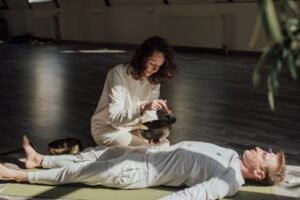
Somatic breathwork sessions can look slightly different depending on the facilitator, the pacing of the practice, and the specific method being used. However, most sessions follow a similar rhythm.
Understanding the general flow can help remove some of the uncertainty many people feel before trying breathwork for the first time. Rather than being something mysterious or overwhelming, a session usually unfolds gradually, allowing your body and nervous system to settle, explore, and integrate the experience step by step.
Grounding and arriving in the body
Most sessions begin by helping you slow down and orient to the present moment. This might involve noticing the support of the floor beneath you, the feeling of your body in the chair or on the mat, or simply observing the natural rhythm of your breath.
You may be guided to bring attention to small sensory details such as the temperature of the room, the weight of your body, or the feeling of your feet touching the ground.
This phase is important because it helps your nervous system settle and creates a sense of safety before moving into more intentional breathing patterns.
Intentional breathing patterns
Once you feel more settled, the facilitator may introduce a specific breathing rhythm. This could include diaphragmatic breathing, circular breathing, or guided inhale-exhale patterns designed to influence energy levels, emotional access, or nervous system regulation.
While the breathing pattern itself plays a role, the deeper focus of somatic breathwork is not simply performing the technique correctly. It is noticing how your internal experience changes as you breathe.
Some people feel calmer and more grounded, while others may notice emotional shifts or increased body awareness. All of these responses are considered part of the process.
Tracking sensation and emotional shifts
As the breathing continues, attention is often directed toward what is happening inside the body.
You might notice subtle or noticeable changes such as warmth, tingling, muscle release, emotional waves, memories, or spontaneous movement. These sensations are not treated as distractions. Instead, they are signals that the nervous system is responding to the breath.
The invitation is not to analyze the experience or force anything to happen, but simply to stay present with whatever arises and allow it to unfold naturally.
Integration and rest
As the session comes to a close, the breathing gradually returns to a natural rhythm. This is usually followed by a period of rest and stillness.
During this time the nervous system begins integrating the experience. Some people notice a sense of calm, emotional release, or physical softness in the body. Others simply feel quieter or more present.
This integration phase is an important part of the practice. It allows the body to absorb the shifts that occurred during the breathing rather than immediately rushing back into activity. This is where everything lands.
Benefits of Somatic Breathwork
People are drawn to somatic breathwork for many reasons. Some come for stress relief. Others come because they feel emotionally blocked, chronically tense, disconnected from their body, or aware that traditional talk-based approaches are not reaching the whole experience.
Nervous system regulation
Because breath directly influences the autonomic nervous system, somatic breathwork can help people move more flexibly between activation and calm. Over time, this may support greater resilience, less reactivity, and a stronger capacity to return to center after stress.
Greater emotional awareness
Many emotions appear first as physical sensations before they become clear thoughts. Somatic breathwork helps people notice those signals earlier, which can make emotional experiences feel less confusing and less overwhelming.
Release of physical tension
Breathing deeply engages the diaphragm, ribs, belly, and chest in ways many people are not used to. As awareness increases, people often notice long-held tension beginning to soften.
Improved mind-body connection
Modern life often trains people to live in their heads. Somatic breathwork gently restores contact with the body, which can create a deeper sense of groundedness and self-trust.
Support for emotional processing
Some people find that breath allows emotions to surface in a way that feels more accessible. Instead of pushing feelings down or becoming consumed by them, the practice supports staying present while they move.
Common Misconceptions About Somatic Breathwork
“It is just deep breathing.”
Not quite. Somatic breathwork is less about breathing deeply for the sake of it and more about using breath to increase awareness of the body and nervous system.
“It has to be intense to work.”
No. Gentle, consistent awareness-based practices can be powerful. More intensity is not always more effective, especially for overwhelmed nervous systems.
“If emotion comes up, something is wrong.”
Not necessarily. Sometimes emotion surfaces because the body feels safe enough to let more of the experience become conscious.
“It is only for trauma.”
It can be supportive for trauma-informed work, but many people use somatic breathwork simply to reconnect with themselves, regulate stress, and build presence.
Is Somatic Breathwork Safe?
Gentle breath awareness and slower body-based breathing practices are generally safe for healthy people. That said, more intense forms of breathwork can sometimes bring up strong physical or emotional responses.
A more supportive way to approach somatic breathwork is to let curiosity guide the experience. Instead of trying to force something to happen, allow the breath to move through your body while you simply notice what arises. From there, begin listening to the signals your body is giving you. You may feel an urge to deepen your breath, shift your posture, place a hand on your chest, or stay with a particular sensation a little longer. Following these small cues helps the body lead the process.
A safer way to approach it
- start gently rather than diving into the most intense method you can find
- stay connected to sensation rather than overriding it
- pause if you feel flooded, numb, dizzy, or overwhelmed
- work with trained support if you have a significant trauma history, panic symptoms, or medical concerns
Somatic breathwork is not about forcing release. It is about becoming deeply present with your physiological body, building the capacity to stay in relationship with your internal experience as it arises, and learning to meet sensation, emotion, and tension with curiosity instead of avoidance.
Jordan Buchan, Founder of Conscious CuesA Simple Somatic Breath Awareness Practice
If you are completely new to somatic breathwork, the best place to begin is not with the most advanced breathing pattern. It is with exercising your awareness.
Try this brief practice
- Sit or lie down somewhere you feel reasonably comfortable.
- Let your breath move naturally for a few moments without trying to change it.
- Place one hand on your chest and one on your abdomen.
- Notice which hand moves more as you breathe.
- Observe any sensations in your ribs, throat, belly, or jaw.
- If thoughts arise, gently return to noticing sensation.
- Stay here for two to five minutes.
This may seem simple, but it begins training the exact skill somatic breathwork is built on: noticing what your body is experiencing in the present moment.
Signs Somatic Breathwork Might Be Helpful
Somatic breathwork may be especially supportive if you notice patterns like:
- frequently feeling disconnected from your body
- chronic tension you cannot seem to “think” your way out of
- stress that shows up physically before you understand it mentally
- difficulty identifying what you feel in the moment
- a sense that talking about your patterns is not enough on its own
None of these mean something is wrong with you. They simply suggest that body-based awareness might be an important missing piece.
Frequently Asked Questions About Somatic Breathwork
Is somatic breathwork the same as regular breathwork?
Not exactly. Somatic breathwork places more emphasis on body awareness, nervous system regulation, and tracking sensations while breathing, rather than focusing only on technique or performance.
Can somatic breathwork release emotions?
It can. Some people notice emotion surfacing during or after practice because the body is becoming more aware of sensations and patterns that were previously held beneath the surface.
Is somatic breathwork evidence-based?
Research on breathing, nervous system regulation, vagal tone, and interoception supports many of the mechanisms that make body-based breath practices meaningful. Specific methods vary, but the broader physiology behind breath and regulation is well established.
Can I practice somatic breathwork on my own?
Gentle awareness-based practices can be done on your own. If you are exploring more intense methods or have a significant trauma history, working with a trained, trauma-informed facilitator is often a wiser place to start.
Why Somatic Breathwork Is Resonating With So Many People
More people are realizing that insight alone does not always change how the body responds to life. You can understand your patterns intellectually and still feel tense, disconnected, or overwhelmed in real time.
That is part of why somatic practices are becoming more relevant. They offer a way to work with the body directly rather than only trying to reason with the mind.
Somatic breathwork speaks to that need. It offers a way to slow down, listen inward, and build a more honest relationship with your own internal experience.
For many people, that is where healing, regulation, and self-trust begin to feel more real.
Somatic Breathwork Protocols
These practices use specific respiratory rhythms as a mechanical lever to influence your physiology. Focus on the texture and location of the breath to unlock the stored tension in your fascia.
The Scanning Inhale
This technique uses the breath as a diagnostic tool. Instead of breathing “into the lungs,” you are using the pressure of the inhale to map out exactly where your body is holding protection.
Visualizing the Breath
Imagine your breath is a bright white liquid filling a glass container. Watch for the cracks or bubbles where the liquid can’t reach, those are your somatic blocks.
The Circular Somatic Loop
A continuous, rhythmic breath that removes the pauses between inhale and exhale. This generates “somatic heat,” helping to thaw out areas of the body that feel numb or “frozen.”
Visualizing the Breath
Imagine a golden ring of light looping from your throat to your tailbone and back again. The faster the loop, the more warmth you generate in your core.
The Vagal Toning Hum
This breath combines deep oxygenation with a vibration. The goal is to stimulate the vagus nerve in the throat and chest to physically shake off high-arousal stress energy.
Visualizing the Breath
Imagine the vibration of the hum is a cleaning brush, scrubbing away the static and noise from your nervous system.
Related resources

Somatic Breathwork for Grief & Loss | Meet Grief & Release Emotions
How to Do Holotropic Breathwork | Deep Step-by-Step

Guided Breathwork for Trauma Release | Therapist-Approved Exercises

Circular Breathwork Practice: What It Is & How to Do It

Neuro-Somatic Educator • Founder, Conscious Cues
Jordan Buchan is the founder of Conscious Cues and a Neuro-Somatic Educator whose work focuses on the process of turning insight into lived experience. She helps people move beyond simply understanding themselves and into embodying real change so what they know begins to shape how they feel, respond, and live.

Psychologist • Certified Kundalini Yoga Instructor
Manuel Alejandro Patiño is a psychologist and certified Kundalini yoga instructor who works where clinical psychology, somatic practice and contemplative tradition meet. He is a certified practitioner of heart-rate variability biofeedback and pulse analysis. He reviews Conscious Cues resources for clinical accuracy.