

You study further. You try applying it in real situations. You meet people who have been immersed in the field for years. You realize there are layers beneath the layer you just discovered. What felt simple now has nuance. What felt universal now has context. What felt like a clean rule now has exceptions.
You realize this subject is endless and the more you learn, the less you feel like you know. All at the same time your confidence drops.
This doesn’t happen because you got dumber. Or because the stuff you learned was wrong. Your confidence drops because your awareness expanded faster than your skill.
Explore the Resource Center
Browse our full library of free worksheets, meditation scripts, and PDF guides. Visit the Resource Center →
Understanding the Dunning–Kruger Effect
The Dunning–Kruger effect explains why people with the least skill in an area are often the most confident about it, while true experts tend to underestimate themselves. Recognizing this pattern in yourself is the first step toward more accurate self-assessment.
The Science of Self-Assessment
This pattern is known as the Dunning–Kruger effect.
In 1999, psychologists David Dunning and Justin Kruger found something surprising. People who are less skilled in a subject often think they’re better at it than they are. Not because they’re arrogant. But because judging your own ability requires understanding what good performance actually looks like.
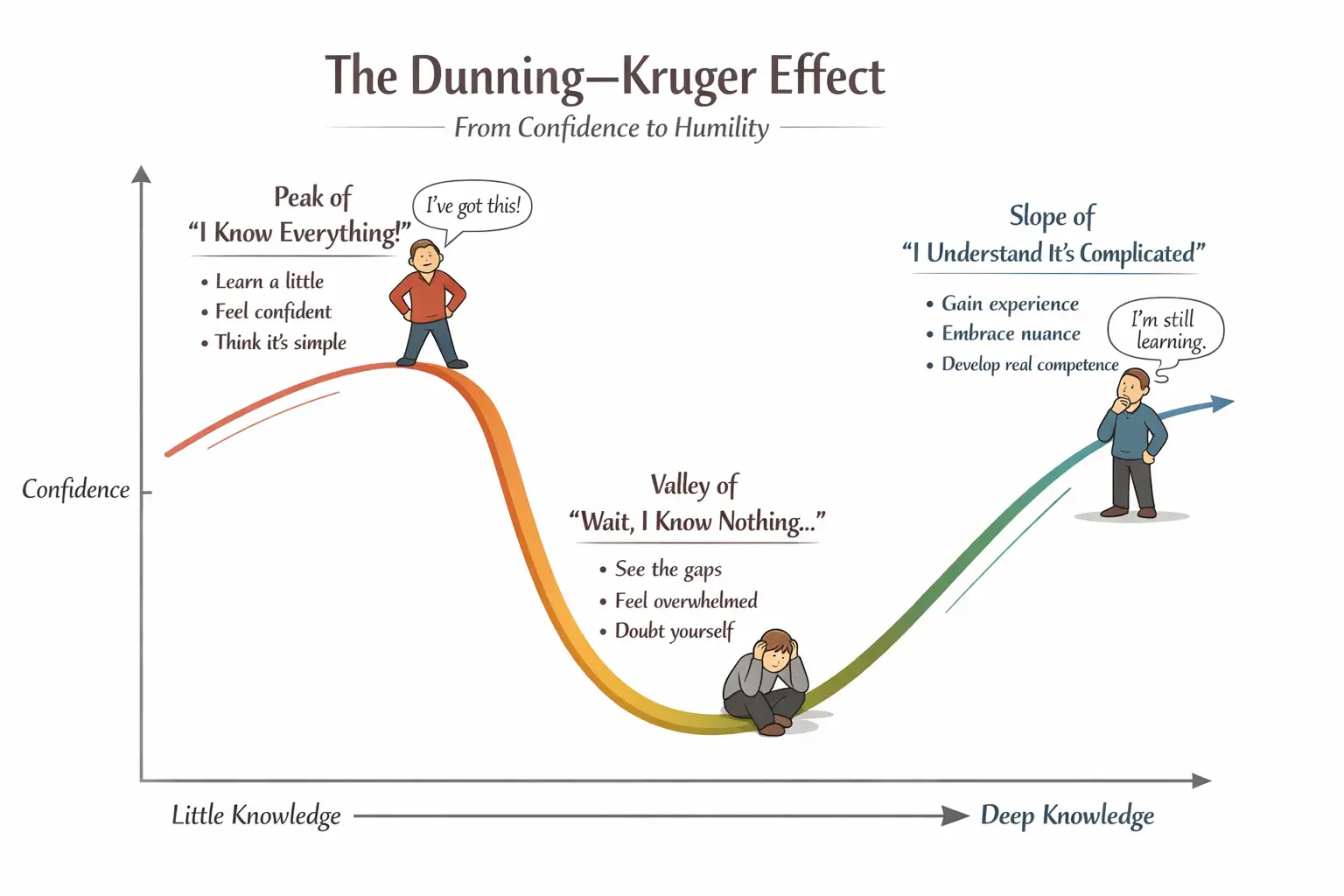
Visualizing the relationship between confidence and competence.
If you’ve only learned the basics, you don’t yet see the depth of the field. You don’t see the advanced techniques, the subtle errors, the nuance. So when you assess yourself, you’re measuring against a very small standard. Your confidence is based on a limited map.
As your knowledge grows, that map expands. You start noticing complexity. You see what you were previously missing. And because your standard just rose, your confidence can temporarily drop.
You didn’t get worse. Your awareness got sharper.
The Early Peak
A little knowledge feels like mastery. The map is small, so it feels complete. Dopamine reinforces progress, but it’s surface expansion.
The Drop
Awareness outpaces confidence. Metacognition improves, you spot blind spots. It feels like failure, but it’s actually the start of real skill.
The Slow Climb
Grounded self-assessment. You know what you know and what you don’t. Confidence becomes stable and precise.
The Brain in the “Messy Middle”
Neurologically, this makes sense. Early learning often activates reward systems in the brain. You’re forming new connections quickly. Dopamine reinforces the sense of progress. It feels like expansion. And it is expansion. But it’s surface expansion.
As you keep going, your metacognition improves. The anterior cingulate cortex, involved in error detection, becomes more active when we notice mistakes or uncertainty. In other words, your brain is now registering nuance. You’re seeing complexity instead of smoothing over it.
This is the stage where many people quit. Or retreat back to oversimplified takes. It’s uncomfortable to realize you were confidently wrong. It’s also the stage where real competence starts forming.
How This Connects to Imposter Syndrome
Imposter syndrome isn’t simply “low confidence.” It’s often a byproduct of increased awareness. The more you learn, the more you realize how much exists beyond your current level. You compare yourself to people further along. Your internal standard rises.
A beginner says: “I’m great at this.”
An intermediate says: “I’m not even close.”
An expert says: “I’m still learning.”
From the outside, that middle stage looks like self-doubt. From the inside, it’s cognitive sophistication. The problem arises when awareness grows but self-trust doesn’t. That gap creates imposter syndrome.
How It Shows Up in Everyday Life
In relationships: You might initially think you’re an excellent communicator because you learned “I feel” statements. Later, you realize your nervous system overrides everything you practiced. Suddenly communication feels harder than before.
In business: Early success feels like proof of genius. Then you scale. Taxes, hiring, leadership psychology, the complexity multiplies. Your certainty softens.
In personal development: Early breakthroughs create the illusion of arrival. Later, you realize insight is not integration. Knowing a concept is different from embodying it under stress.
Working With the Curve
1. Expect it: Assume your confidence will spike and then dip. If you know the dip is part of the process, it won’t destabilize you as much.
2. Separate identity from skill: Skill development is mechanical. Your worth does not fluctuate with your level of mastery.
3. Track objective evidence: Imposter syndrome feeds on feeling. Look at outcomes, feedback, and measurable progress. Data matters.
4. Adjust your comparison field: Learn from those ahead. Mentor those behind. Teaching consolidates knowledge.
5. Build Calibrated Confidence: Precision reduces both arrogance and imposter syndrome. “I am competent in this range. Beyond that, I’m still learning.”
A Practical Reflection
Choose one domain (emotional work, leadership, craft, relationships) and ask:
- Where might I be overestimating my competence because I haven’t seen the depth yet?
- Where might I be underestimating my competence because my standards grew faster than my skills?
- What actual evidence supports my current level?
- If I removed comparison, how would I assess myself based on progress alone?
The Dunning–Kruger effect isn’t an insult to beginners. It’s simply a pattern in how learning works. If you feel like you don’t know enough, that isn’t automatically a problem. It may mean your awareness has expanded.
The goal isn’t to feel certain. The goal is to build skill until your confidence matches your expanded understanding.
Frequently Asked Questions
What is the Dunning-Kruger effect in simple terms?
The Dunning-Kruger effect describes a cognitive bias where people with limited knowledge or skill in an area tend to overestimate their competence, because the same lack of knowledge that causes poor performance also prevents them from recognizing it.
Does the Dunning-Kruger effect mean confident people are always wrong?
No. Confidence and competence are correlated for most people, especially as expertise grows. The effect specifically describes a mismatch that tends to appear at the very beginning of learning something, not a universal rule that confidence equals incompetence.
How can I tell if I’m experiencing the Dunning-Kruger effect?
It’s hard to self-diagnose in the moment, since the bias affects self-awareness itself. Useful signs include rarely seeking outside feedback, dismissing expert opinions that differ from yours, or feeling surprised when your assumptions turn out to be wrong. Actively seeking feedback is the best countermeasure.
Why do experts sometimes seem less confident than beginners?
As people gain real expertise, they become more aware of the field’s complexity and nuance, which naturally makes them more cautious about overstating their certainty. This is sometimes called the “valley of despair” in the Dunning-Kruger curve, where confidence dips before rising again with true mastery.
Is the Dunning-Kruger effect real, or has it been debunked?
The core finding, that people with low skill in a domain tend to overestimate their ability, has been replicated across many studies, though some researchers debate whether the effect is better explained by statistical noise (regression to the mean) rather than a true psychological bias. Most psychologists still consider it a real, if nuanced, phenomenon.
What is the Dunning-Kruger effect exactly?
It’s a cognitive bias, first documented by psychologists David Dunning and Justin Kruger in 1999, where people with limited knowledge or ability in a specific area tend to overestimate their own competence, because the skills needed to perform well are often the same skills needed to recognize poor performance.
Related resources

The Feelings Wheel | List of Feelings – Understanding Your Emotional Intelligence
List of Feelings: 91 Words for What You’re Actually Feeling (Free PDF)
Feelings Wheel Activities: A Four-Week Workbook You Can Print
Boundaries Worksheet PDF — Six Types, Scripts and a Hold Line

Neuro-Somatic Educator • Founder, Conscious Cues
Jordan Buchan is the founder of Conscious Cues and a Neuro-Somatic Educator whose work focuses on the process of turning insight into lived experience. She helps people move beyond simply understanding themselves and into embodying real change so what they know begins to shape how they feel, respond, and live.

Licensed Therapist
Manuel A. Patino reviews Conscious Cues resources for clinical accuracy. Full bio coming soon.