
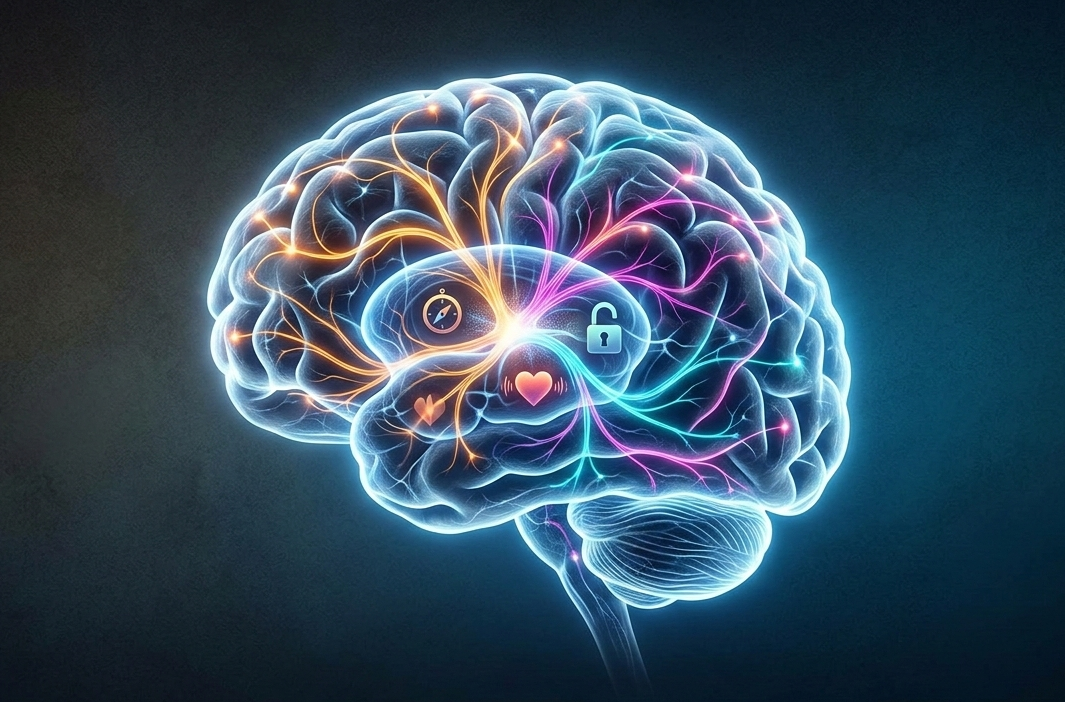
Neuroplasticity Exercises Guided Walk-through
Jordan will walk you through these specific protocols to help you rewire automatic patterns and build new neural pathways.

Training Your Brain
Practices That Rewire Habits
Most habits feel automatic because, at a brain level, they are. The more often you repeat a thought, movement, reaction, or routine, the more efficiently your nervous system learns to run that pattern without asking for much conscious input.
This is one of the brain’s great strengths. You do not want to relearn how to walk, type, drive, speak, or brush your teeth every single day. The brain is designed to conserve energy by turning repeated actions into shortcuts.
But this same efficiency can keep us stuck. The brain does not automatically separate “helpful” patterns from “unhelpful” ones. If a behavior is repeated often enough, whether it is checking your phone, spiraling into self-criticism, shutting down emotionally, or reaching for comfort in the same old way, the pathway gets stronger simply because it keeps getting used.
The encouraging part is that the brain remains plastic throughout life. Neuroplasticity means the brain can form new connections, strengthen new patterns, weaken old ones, and become more efficient at behaviors you practice deliberately. Change is not instant, and it is not magic, but it is possible. The brain is always adapting to what you repeatedly ask it to do.
The exercises in this guide are not meant to feel rigid or mechanical. They are small, practical ways to help your brain wake up, pay attention again, and begin building pathways that support more focus, awareness, emotional regulation, and intentional action.
Before You Start: What Actually Changes When You Practice Something Repeatedly?
When you practice a new behavior, several things can happen in the brain at once. Neurons that fire together begin forming stronger connections. Attention-related chemicals help the brain flag certain experiences as important. Repetition makes the pathway more efficient, so the behavior starts requiring less effort over time. And when a habit is interrupted often enough, the older pathway can gradually lose some of its strength.
That means change is not only about “trying harder.” It is also about giving the brain enough repetition, enough novelty, and enough intentional practice to reorganize itself. Some exercises below help with attention. Some help with body awareness. Some help weaken automatic habits. Others help build new ones. Together, they work on different parts of the same system.
1. Repetition builds efficiency
The more often a pathway is used, the more quickly the brain learns to travel it. Repeated behaviors become easier not because you suddenly became “better,” but because the pathway became more familiar and efficient.
2. Attention tells the brain what matters
Novelty, effort, and focused awareness help the brain mark an experience as important. This increases the likelihood that the pathway will be strengthened instead of forgotten.
3. Old pathways can weaken too
The brain does not only grow through strengthening. It also changes through pruning, reduced use, and disruption of automatic loops. Not feeding an old pattern matters almost as much as practicing a new one.
Using Your Non-Dominant Hand
One of the easiest ways to interrupt autopilot is to make a familiar movement unfamiliar again. Using your non-dominant hand may seem simple, but it is one of the fastest ways to make the brain re-engage with a task it normally runs on habit.
The Practice
- Choose a simple daily task like brushing your teeth, opening doors, eating with a spoon, or using your computer mouse.
- Do the task with your non-dominant hand for 5 to 10 minutes.
- Slow down instead of rushing through the awkwardness.
- Focus on the sensation of needing to pay attention again.
Why This Helps
Many daily actions are handled largely by the basal ganglia, which help automate repeated behaviors. Once a movement is familiar enough, the brain stops devoting much conscious effort to it.
Switching hands interrupts that smooth, practiced route and forces the prefrontal cortex to re-engage. Instead of gliding through the task, you have to think, adjust, and coordinate in real time. That extra effort is exactly what makes the brain pay attention.
What is happening in the brain?
Unfamiliar movement requires the motor cortex to build and refine new patterns of coordination. This can involve synaptogenesis, the formation of new synaptic connections, along with increased communication across regions responsible for movement planning, attention, and error correction.
Challenging tasks also increase the release of acetylcholine, a neurotransmitter involved in attention and learning. Acetylcholine helps the brain highlight which signals matter, making it more likely that the new experience will be encoded and improved with repetition.
In plain language: the clumsy feeling is not a sign you are bad at it. It is a sign your brain has stopped running the old shortcut and is building a new route.
Training Your Attention
Most people think attention training means trying to “empty the mind.” It does not. The real skill is learning how to notice where attention goes, and then gently bring it back on purpose.
The Practice
- Set a timer for 5 to 7 minutes.
- Focus on one simple anchor, such as the sensation of your breath at the nose or the rise and fall of the chest.
- Each time your mind drifts, label it lightly with something like “thinking,” “planning,” or “remembering.”
- Bring your attention back without judging yourself for wandering.
Why This Helps
Thoughts are not the problem. The brain generates thoughts constantly. What matters is whether your attention gets dragged around automatically, or whether you can notice that drift and choose where to place your focus.
This builds the brain’s executive attention system, especially the networks involved in monitoring conflict, detecting distraction, and shifting back toward what matters. Over time, this can support better concentration, less reactivity, and more space between impulse and action.
What is happening in the brain?
When the mind wanders, activity often increases in the Default Mode Network, a group of regions associated with self-referential thinking, mind-wandering, and rumination.
Each time you catch that wandering and redirect attention, you recruit the anterior cingulate cortex and parts of the prefrontal cortex involved in cognitive control. This strengthens the brain’s ability to monitor distraction and reorient itself.
In simple terms: you are not practicing “not thinking.” You are practicing coming back. And with repetition, coming back becomes easier in meditation, in conversations, during stress, and in daily life.
Listening to Your Body
A lot of people do not notice they are stressed until they are already snappy, overwhelmed, shut down, or emotionally flooded. This practice helps you catch body signals earlier, before they snowball into a bigger reaction.
The Practice
- Pause three times per day.
- Close your eyes or soften your gaze for a moment.
- Notice your heartbeat, breathing, stomach, jaw, shoulders, chest, or any area holding tension.
- Stay with the sensation for 60 seconds without immediately trying to fix it.
Why This Helps
This strengthens interoception, your ability to sense internal bodily states. Interoception is a huge part of emotional awareness. If you cannot sense what is happening inside your body, it becomes much harder to regulate what is happening inside your mind.
Many people move through the day overriding hunger, fatigue, anxiety, tension, and emotional activation until it spills out sideways. Building body awareness creates more choice. You begin to notice the first signs of activation instead of only noticing the fallout later.
What is happening in the brain?
Interoceptive signals are strongly associated with the insular cortex, a region that helps translate internal bodily information into conscious awareness. The insula acts like a bridge between body sensation and emotional meaning.
With repetition, this kind of attention can improve emotional granularity, which is the ability to distinguish between states that might otherwise blur together. Instead of reading everything as “bad,” “overwhelming,” or “something is wrong,” the brain starts getting more specific.
That specificity matters. It is easier to respond wisely when you can tell the difference between hunger, dread, grief, pressure, agitation, exhaustion, or shame.
Interrupting Automatic Habits
Sometimes change does not start with doing the new thing perfectly. Sometimes it starts with creating just enough space to interrupt the old thing.
The Practice
- Choose one small habit you want to change, like checking your phone, biting your nails, scrolling when anxious, or reaching for sugar automatically.
- When the urge appears, pause for 15 seconds before acting.
- Notice what the urge feels like in the body. Is it tension, restlessness, pressure, anticipation, discomfort?
- After 15 seconds, choose consciously what you want to do.
Why This Helps
Habits feel automatic because the brain learns to link a cue directly to a routine. The urge appears, and before you fully realize it, the behavior has already begun.
Pausing reintroduces the prefrontal cortex into that loop. It creates what you might call a wedge of consciousness. Instead of the cue launching the routine instantly, there is a moment in which you can observe, feel, and choose.
That moment may seem tiny, but it changes the structure of the pattern.
What is happening in the brain?
Repeatedly interrupting a habit can reduce the strength of the old pathway through a process known as long-term depression (LTD). LTD does not mean “depression” in the emotional sense. It refers to a weakening of synaptic efficiency when a connection is not reinforced in the usual way.
The old pathway is no longer getting the same clean, immediate reward it is used to. Over time, that can make it less dominant. Meanwhile, the act of pausing strengthens newer pathways associated with awareness, inhibition, and choice.
In everyday language: you are teaching the brain that an urge is not a command.
Changing What Your Brain Expects
The brain is constantly predicting what comes next. It uses past experience to guess what your environment means, what sensations matter, and what to pay attention to. This keeps life efficient, but it can also make the brain stop noticing what is actually present.
The Practice
- Choose a safe, familiar environment like your room, kitchen, or office.
- For 3 to 5 minutes, alter the way you move through it by downplaying one sense. You might close your eyes briefly while standing still and identifying sounds, or wear earplugs while slowly touching surfaces and noticing texture.
- Move slowly and carefully. Safety comes first.
- Notice details your brain usually filters out.
Why This Helps
The brain filters out a massive amount of information because it assumes it already knows what is there. When you alter the expected sensory input, the brain experiences a prediction error. Something about the situation does not match its usual model.
Prediction error is important because it signals that the current map may need updating. That is when the brain becomes more attentive, more curious, and more receptive to learning.
What is happening in the brain?
Novel and surprising experiences can activate the locus coeruleus, a brainstem region associated with the release of norepinephrine. Norepinephrine helps increase alertness, sharpen attention, and prepare the brain to update its internal predictions.
In other words, when the brain realizes “this is not exactly what I expected,” it stops coasting and starts learning again.
This matters far beyond the room you are standing in. A brain that becomes more flexible in one area often becomes more open to change in others too.
Rehearsing the Behavior You Want
The brain does not learn only through action. It also learns through vivid mental rehearsal. Imagining a behavior in detail can begin preparing the neural pathway before you physically do the thing.
The Practice
- Choose one specific behavior you want to become easier, like getting out of bed, starting a workout, opening your journal, or beginning a hard task.
- Sit quietly and imagine yourself doing it from a first-person point of view.
- Include sensory details: your muscles moving, your feet on the floor, the sound in the room, the sequence of each step.
- Repeat the rehearsal 5 to 10 times, especially before sleep if possible.
Why This Helps
One reason certain habits feel hard is that the brain has not yet built an easy route into them. Mental rehearsal gives the nervous system a preview of the movement or behavior before the real-world friction shows up.
This lowers the “startup cost” the next time you try to act. The behavior still requires effort, but it no longer feels completely unfamiliar.
What is happening in the brain?
Mental rehearsal can activate the supplementary motor area, parts of the motor cortex, and other circuits involved in planning and sequencing movement.
The brain begins encoding the action as something it has already partially practiced. When done before sleep, rehearsal may also benefit from sleep-dependent consolidation, the process by which the brain strengthens and organizes recent learning during sleep.
In simple terms: the brain is more willing to do tomorrow what it has already been introduced to tonight.
Balancing Movement and Thinking
This exercise combines physical coordination with mental effort. It is less about performing beautifully and more about asking the brain to coordinate multiple systems at once.
The Practice
- Stand on one leg, or balance on a folded towel or cushion if that feels safe.
- While balancing, do a mental task such as reciting the alphabet backward, naming animals, or counting by threes.
- Continue for 1 to 3 minutes.
- If you lose balance or lose track of the words, gently restart.
Why This Helps
Balance involves coordination between sensory input, body position, and movement correction. Adding a verbal or cognitive task increases the load on attention and working memory.
This asks the brain to distribute resources more efficiently instead of relying on a single narrow channel. It can improve your ability to stay present and functional when more than one demand is happening at once.
What is happening in the brain?
The cerebellum helps fine-tune movement, balance, timing, and error correction. The prefrontal cortex supports working memory, mental sequencing, and cognitive control.
When you combine physical and mental challenge, these systems have to communicate more efficiently. That kind of cross-network practice may help build cognitive flexibility and improve your ability to stay regulated when your brain is under load.
In everyday life, that can translate into thinking more clearly while stressed, staying more articulate when emotional, and tolerating complexity without shutting down as fast.
Learning Something Difficult
The brain changes most when it is stretched, not when it is coasting. Easy repetition can help maintain skills, but genuine learning happens at the edge of your ability, where the brain has to adapt.
The Practice
- Choose a skill that is new and slightly frustrating, such as simple piano notes, basic juggling, knitting, drawing with your non-dominant hand, or learning a dance pattern.
- Practice for 10 to 15 minutes.
- Stay in the zone where it feels effortful but still possible.
- If it becomes too easy, make it slightly harder.
Why This Helps
When a task is genuinely new, the brain cannot rely entirely on old models. It has to pay attention, encode details, detect mistakes, and refine performance. That is exactly the terrain where neuroplastic change becomes more likely.
This kind of learning also builds tolerance for being a beginner, which is no small thing. Many people are not actually bad at change. They are just deeply uncomfortable with the feeling of not being good yet.
What is happening in the brain?
Novel learning is associated with increased activity in networks involving the hippocampus, attention systems, and motor or sensory regions relevant to the task. Challenging learning may also support the release of BDNF, or brain-derived neurotrophic factor.
BDNF is often described as a growth-support protein because it helps support neuron survival, synaptic plasticity, and learning. It does not mean one hard task instantly transforms your brain, but repeated challenging learning creates conditions that support adaptation.
In plain language: new skills remind the brain it is still capable of changing.
Rewriting Your Inner Narrative
The brain is shaped not only by movement and habit, but by repeated language. The thoughts you rehearse most often can become some of the deepest grooves in your internal world.
The Practice
- Notice one recurring self-critical thought, such as “I always mess this up” or “I’m not good at this.”
- Replace it with something grounded and believable, such as “I’m still learning this,” “This is uncomfortable, not impossible,” or “I do not need to be perfect to keep going.”
- Say the new thought out loud if possible.
- Repeat consistently whenever the old thought appears.
Why This Helps
The brain does not erase old thoughts simply because you decide you do not like them anymore. It changes more effectively when you build a stronger alternative pathway that can compete with the old one.
Replacing a familiar thought with a new one gives the brain something else to practice. Speaking it aloud adds motor and auditory input, which can make the new pathway more embodied and memorable.
What is happening in the brain?
Repeating a new thought can support long-term potentiation (LTP), which is the strengthening of synaptic connections through repeated activation. At the same time, if the older thought is fed less often, its pathway may gradually lose some of its dominance.
When you speak the new thought aloud, additional regions involved in speech production, hearing, and sensory feedback become part of the loop. This creates a richer pattern for the brain to encode than silent correction alone.
In practical terms: you are not trying to “positive-think” your way out of reality. You are trying to stop rehearsing the same damaging script so often that it starts feeling like truth.
Anchoring Habits With Sensory Cues
The brain learns through association. If you repeatedly pair a new habit with a consistent sensory cue, the cue itself can begin nudging the brain toward the behavior.
The Practice
- Choose one positive habit you want to strengthen, such as journaling, stretching, reading, or breathwork.
- Pair it with a specific scent, sound, playlist, tea, lighting cue, or location.
- Use that cue only with this habit if possible.
- Repeat the pairing for at least 10 to 14 days.
Why This Helps
Starting a new habit can feel hard because the brain has not built a strong entry point into it yet. Sensory cues can lower the barrier by giving the nervous system a familiar signal that says, “this is what we do now.”
Over time, the cue itself can begin priming the brain for the behavior, making it feel less forced and more natural to begin.
What is happening in the brain?
The brain is constantly forming associations between experiences. Smell, sound, environment, and emotion are all closely linked to memory systems. In particular, scent has a strong connection with circuits involving the amygdala and hippocampus, which help encode emotional and contextual memory.
Repeated pairing can create a neural anchor. The cue starts predicting the routine, and prediction helps the brain prepare for action. This is one reason rituals and consistent setups are so powerful.
In simple terms: you are making it easier for the brain to recognize the doorway into the habit.
How to Work With These Exercises Without Overwhelming Yourself
You do not need to do all ten exercises every day. In fact, trying to do everything at once often creates the exact kind of cognitive overload that makes change harder to sustain.
A better approach is to choose two or three practices based on what you most want to strengthen right now:
If you want more focus
Start with Training Your Attention, Using Your Non-Dominant Hand, and Balancing Movement and Thinking.
If you want to break habits
Start with Interrupting Automatic Habits, Changing What Your Brain Expects, and Anchoring Habits With Sensory Cues.
If you want more self-awareness
Start with Listening to Your Body, Training Your Attention, and Rewriting Your Inner Narrative.
The deeper shift comes from consistency, not intensity. The brain does not need dramatic effort nearly as much as it needs repeated, meaningful input. Small, regular reps are what turn an interesting idea into a lived pattern.
Neuro-Somatic Educator • Founder, Conscious Cues
Jordan Buchan is the founder of Conscious Cues and a Neuro-Somatic Educator whose work focuses on the process of turning insight into lived experience. She helps people move beyond simply understanding themselves and into embodying real change so what they know begins to shape how they feel, respond, and live.

Neuroscientist & Psychotherapist