
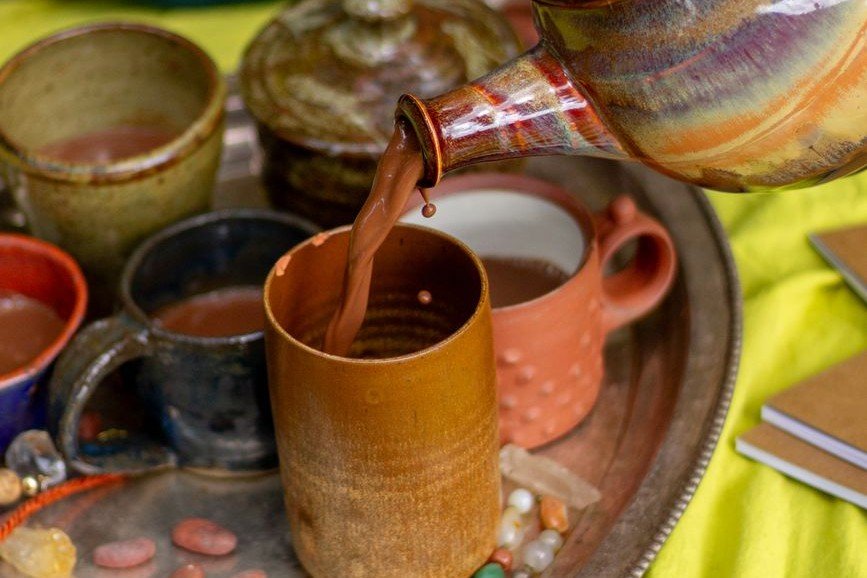
Ceremonial Cacao:
Technical & Ritual Protocol
Explore the Resource Center
Browse our full library of free worksheets, meditation scripts, and PDF guides. Visit the Resource Center →
1. Preparation by Form
How you handle the raw material determines the texture and the “activation” of the medicine. Specificity is key.
Solid Blocks or Discs (The Tradition)
This is the pure stone-ground paste hardened into a brick.
The Mechanics: Do not just break off a chunk. Use a large, sharp chef’s knife to finely shave the corner of the block. You want thin, feathery flakes. Large chunks will not melt evenly and will create a “waxy” mouthfeel. Shave until you have a pile that looks like dark brown snow.
Pre-Shaved or Ground Cacao (The Modern Way)
Ensure it is pure ceremonial grade (fermented, sun-dried, stone-ground).
The Mechanics: Since it is already broken down, it is prone to clumping if added to cold water. Measure it by weight (grams) rather than volume (spoons) for accuracy. This form is best suited for a blender to ensure a frothy head.
Cacao Nibs (The Raw Seed)
These are crushed beans, not a paste. They require a mechanical process to become a drink.
The Mechanics:
1. Lightly toast in a dry pan for 30–60 seconds to release the oils.
2. Blend with hot water and 1 tsp of healthy fat (coconut oil/cacao butter) on high for 60 seconds.
3. Crucial: Strain through a nut milk bag or fine mesh. If you don’t strain, it will be gritty and undrinkable.
2. Ingredients & Metrics
- ◈ Dosage: 20g (Daily Connection) to 40g (Deep Ceremony). Do not exceed 50g in one sitting.
- ◈ Liquid: 1/2 to 3/4 cup of water. For a creamier texture, use half water and half nut milk (oat/almond).
- ◈ The Temperature: Heat liquid to 180°F (82°C).
3. The Build: Step-by-Step
| 01 | Pause and Set Intention: Before you touch the heat, breathe. State why you are here. What are you asking for? What are you opening to? This is not a recipe; it is a ritual. Presence makes it ceremonial. |
| 02 | Heat Liquid: Heat your water/milk separately. Never microwave. If you don’t have a thermometer, let boiling water sit for 2 minutes before using. |
| 03 | Combine: Put your chopped/shaved cacao into a blender or a small pot. Add the hot liquid.
Blender: Pulse for 20 seconds. Stovetop: Use a whisk or traditional Molinillo. Stir in a circular, rhythmic motion until the surface is frothy. |
| 04 | Alchemy: Add optional ingredients (Cinnamon, Cayenne, Sea Salt, Raw Honey) only after the cacao is fully melted. Taste as you go. Respect the natural bitterness. |
4. Why It Works: The Bio-Alchemy
In Indigenous lineages (Mayan/Aztec), cacao was the “Food of the Gods.” It was a tool for “heart-to-heart” talking (Platica). Physically, this happens because of three things:
- Theobromine: A vasodilator that opens the heart’s blood flow without the caffeine crash.
- Anandamide: The “bliss molecule” that relaxes the nervous system.
- Indigenous Root: It was used to bridge the gap between the human and divine. You are drinking a 3,000-year-old unbroken tradition of earth-reverence.
Frequently Asked Questions
What is ceremonial cacao?
Ceremonial cacao is a minimally processed form of cacao, made from whole cacao beans, traditionally used in ritual and community settings for its heart-opening effects and rich, complex flavor. It differs from commercial cocoa or chocolate, which are more heavily processed and often stripped of certain beneficial compounds.
How is ceremonial cacao different from regular hot chocolate?
Ceremonial cacao is unsweetened, minimally processed, and typically made from whole cacao paste rather than powder with added sugar and dairy. It’s prepared with intention and often consumed on an empty stomach, unlike hot chocolate, which is a sweetened comfort drink.
Does ceremonial cacao have psychoactive effects?
Ceremonial cacao is not psychoactive like plant medicines, but it does contain compounds like theobromine and small amounts of anandamide, which can produce a gentle mood-lifting, heart-opening, and mildly stimulating effect for many people, without causing intoxication.
How much ceremonial cacao should I use for one serving?
A common starting dose is around 20-42 grams (roughly 1-1.5 ounces) of cacao paste per serving, though amounts vary based on sensitivity and intention. It’s wise to start on the lower end, especially the first time, since cacao does contain caffeine-like stimulants.
What is a cacao ceremony?
A cacao ceremony is a guided, intentional gathering centered around drinking ceremonial-grade cacao, often paired with meditation, music, sharing, or movement, designed to support emotional openness, connection, and presence within a group or personal ritual setting.
Is ceremonial-grade cacao different nutritionally from regular cocoa powder?
Ceremonial cacao retains more of the natural fat (cacao butter) and bioactive compounds like theobromine and flavonoids since it undergoes minimal processing, unlike Dutch-processed cocoa powder, which is alkalized and often stripped of some of these compounds. Sources like Harvard’s Nutrition Source cover the broader health research on cacao flavonoids.

Neuro-Somatic Educator • Founder, Conscious Cues
Jordan Buchan is the founder of Conscious Cues and a Neuro-Somatic Educator whose work focuses on the process of turning insight into lived experience. She helps people move beyond simply understanding themselves and into embodying real change so what they know begins to shape how they feel, respond, and live.