5 Senses Grounding PDF
For Nervous System Safety
A professional facilitation guide to the 54321 Grounding Method. Master the five senses grounding protocol to interrupt high-arousal states and restore physiological regulation.
54321 Grounding Protocol
The definitive five senses grounding framework for clinical anxiety management and emotional regulation.
Access the full collection of somatic and mindfulness tools.
Mastering the 54321 Grounding Technique
The 54321 grounding technique is a powerful somatic tool designed to pull the nervous system out of high-arousal states like anxiety, panic, and dissociation. By systematically engaging in five senses grounding, practitioners can help clients create a "sensory anchor" that interrupts the fight-or-flight response and restores cognitive function.
Unlike simple distraction, the 54321 method works by facilitating "dual awareness"—the ability to acknowledge internal distress while simultaneously recognizing the safety of the external environment. This Therapist Approved protocol is essential for anyone navigating emotional dysregulation or trauma triggers.
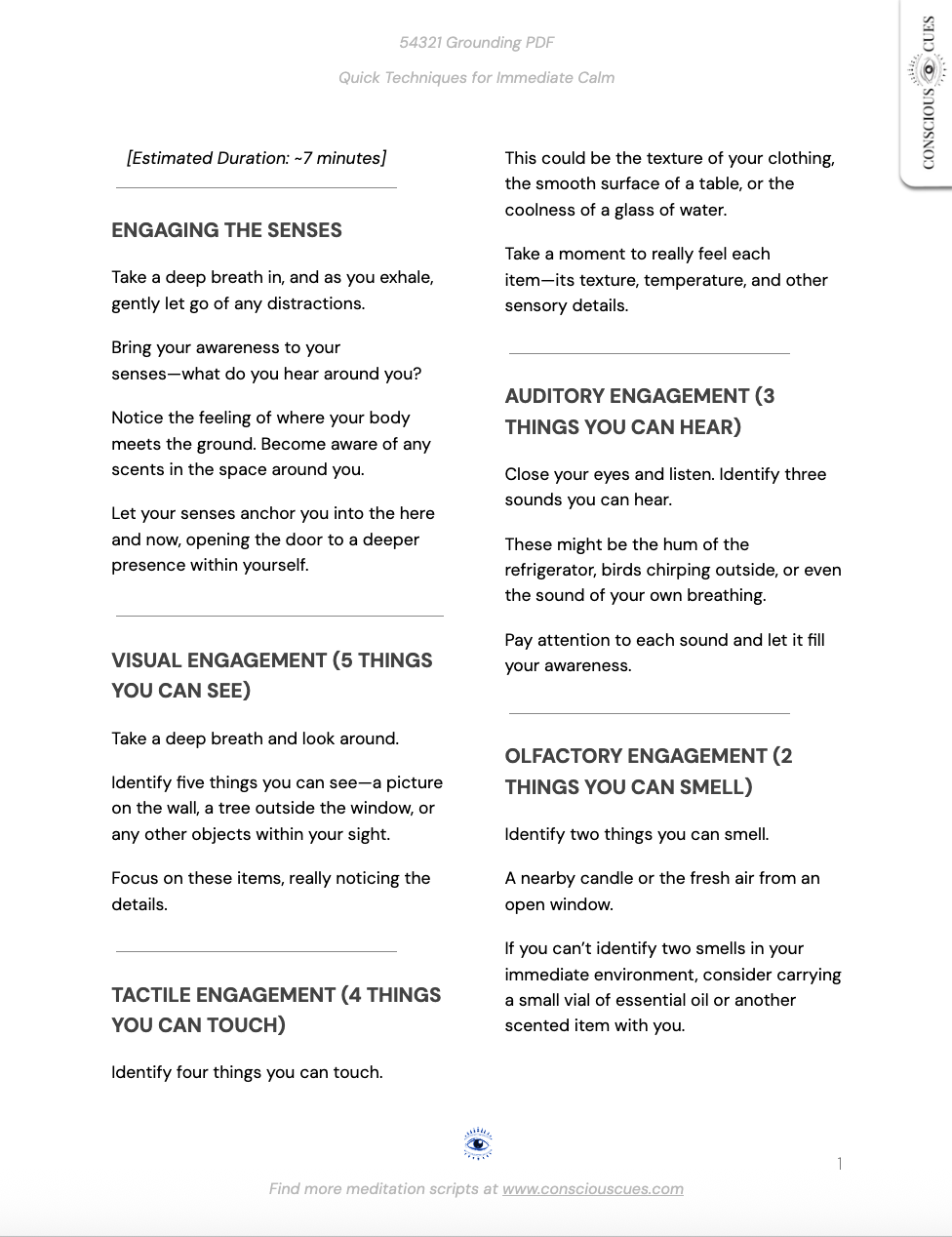
How to Perform Five Senses Grounding
5: SEE
Acknowledge five things you see around you. Focus on small details: the way light reflects off a window, a specific pattern on a rug, or a speck of dust on a table.
4: FEEL
Acknowledge four things you can touch. Notice the texture of your shirt, the pressure of your back against a chair, or the temperature of your skin.
3: HEAR
Acknowledge three things you hear. Listen for distant sounds—like birds or traffic—and closer sounds, like the hum of an air conditioner or your own breath.
2: SMELL
Acknowledge two things you can smell. If the air feels neutral, try to smell your wrist, a nearby cup of coffee, or the scent of the room itself.
1: TASTE
Acknowledge one thing you can taste. Notice any lingering flavors, or simply focus on the physical sensation of your tongue and jaw softening.
The Science of Safety
During a panic attack, the amygdala (the brain's alarm) triggers a survival loop. The 54321 method forces the prefrontal cortex back "online" by requiring high-level categorization. This biological shift tells the nervous system the emergency is over.
This "bottom-up" regulation is why five senses grounding is more effective than "just thinking positive"—it addresses the body's physiology directly.
Common Pitfalls
- Rushing the process: Speed-running the numbers reduces the regulatory effect. Take one full breath per sense.
- Performance Pressure: Don't worry if you can't find a smell or taste. The search for the sense is what regulates the brain.
- Waiting for Crisis: Practice this during calm moments to "grease the groove" for your neural pathways.
54321 Grounding FAQ
What is the 54321 grounding technique? +
It is a mindfulness and somatic intervention that uses the five senses to ground an individual in the present moment. It is widely used for anxiety, PTSD, and stress management.
Can I use this for social anxiety? +
Absolutely. One of the biggest advantages of five senses grounding is that it can be performed silently and internally, making it an ideal tool for social situations or public environments.
Why is it called the 5-4-3-2-1 method? +
The name refers to the countdown of senses: 5 sights, 4 touches, 3 sounds, 2 smells, and 1 taste. The descending order helps focus the mind as the exercise progresses toward deeper internal awareness.