
Grief is not a staircase.
This is the book that treats it that way.
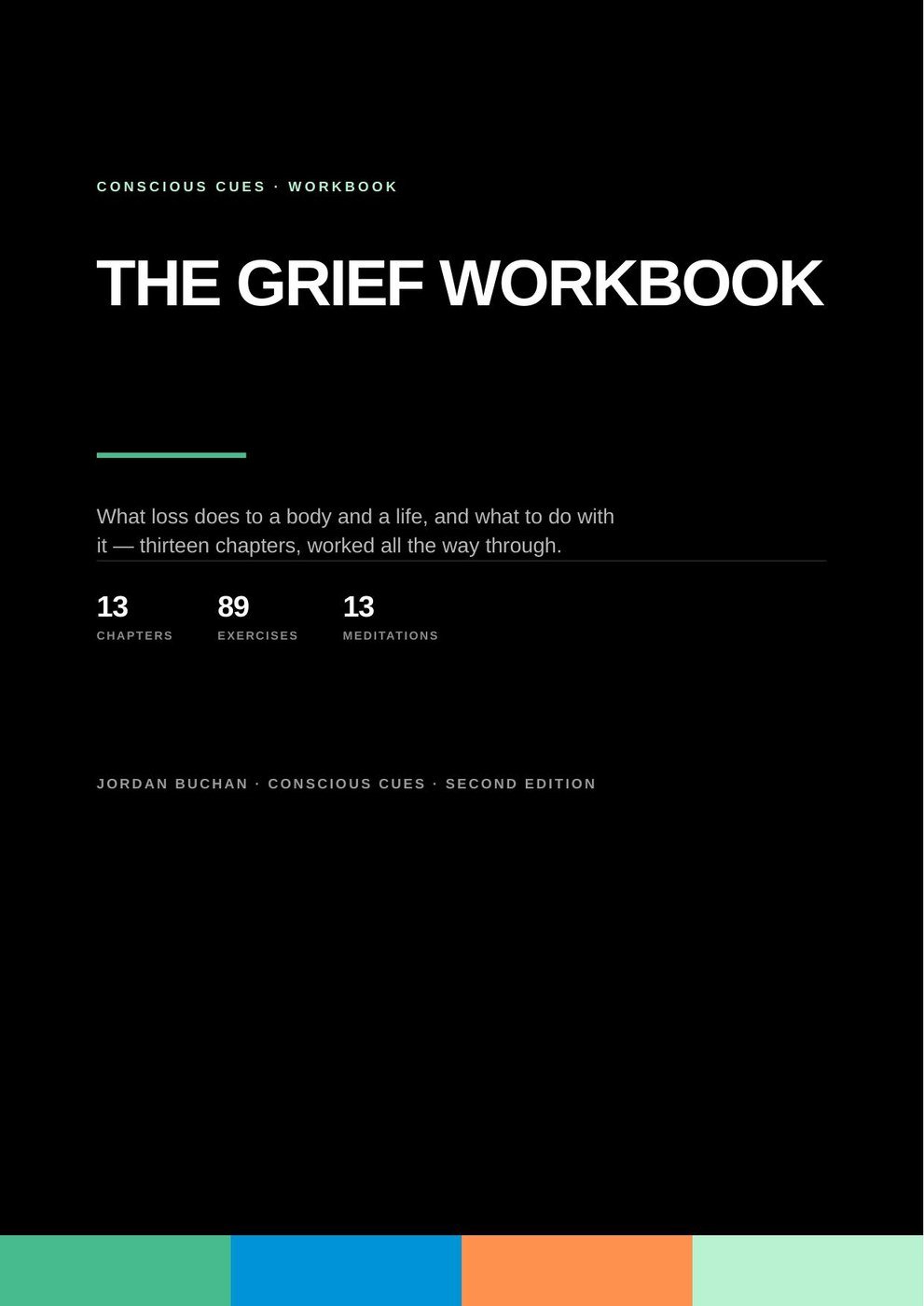
Thirteen chapters, eighty-nine exercises you fill in with a pen, and a map on page five that asks what is loudest today and sends you straight to the page that deals with it. Including the page for when the answer is “nothing, and that frightens me”.
- 89 exercises you fill in, not read
- 13 guided meditations, written out line by line
- A diagnostic chapter for symptoms you cannot explain
- Eight tear-out cards for the supermarket and 3am
- A fourteen-week plan you are allowed to fall behind on
Instant access · Print it or work on screen · 30-day refund, no questions
You do not have to know where to start
Most grief books open at chapter one and assume you can read a book. In the first weeks you cannot, and two years in you do not need to — you need the four pages that are actually about your problem.
So page five is a router. Sixty sentences, grouped by what is loudest, each pointing at a real page number:
You can use the whole book and never read it front to back. Plenty of people will.
What is underneath this
Grief almost never announces itself as grief. It announces itself as not eating, not sleeping, snapping at someone who did nothing, or a flat nothing where the sadness was supposed to be.
Chapter five takes each of those symptoms and lists what is commonly underneath it — because the handling is completely different. Not eating because meals were the thing you did together is a different problem from not eating because anxiety has shut your stomach down, which is different again from not eating because part of you is furious and has nowhere to put it.
Then it gives you a way to find out which one is yours. Most people working through it honestly find at least one thing they had not seen, and it is usually the thing that has been running the show.
Thirteen chapters, in the order these things tend to arrive
Then: twenty-one rituals for remembering and for putting something down, a section on being kinder to yourself, eight tear-out cards, ten groups of affirmations that are true on the bad days, and a fourteen-week plan with two rest weeks built in.
Neuroscience, psychology, the body, and how other cultures do it
Each chapter carries the same four lenses, each with a plain-terms box for the days when you cannot read carefully. The cultural lens is there because the English-speaking world kept the funeral and dropped almost everything after it, and most traditions that handle grief well do the opposite.
Where the book is summarizing someone else’s work — Stroebe and Schut on oscillation, Klass and Silverman on continuing bonds, Doka on disenfranchised grief, Boss on ambiguous loss, Tonkin on growing around it, Neff on self-compassion — it says whose work it is.
Who this is not for
It will help if
- You want something to do, with a pen, rather than something to read
- Your grief does not fit the shape people expect of it
- Nobody around you thinks your loss counts
- You are years in and still get taken out by it
- You are the one holding everyone else up
It will not help if
- You want a book that promises stages, closure, or a timeline
- You are in the first few days and cannot hold a pen — come back
- You want someone to tell you it was meant to be
- You need a therapist. This is not one, and it says so on page two
What has not been reviewed
Nothing in this workbook has been clinically reviewed. It has not been read by a therapist, a grief specialist or a physician before publication. It is built from the research it cites, from work with people in the Conscious Cues community, and from reading well outside one person’s experience.
I would like that to change in a later edition. Until it does, this paragraph stays on the sales page as well as in the book.
Twelve of the worksheets are free
If you want to know whether this way of working suits you before paying for it, take the free grief worksheets. Twelve printable pages drawn from the same book — the symptom map, the body map, the trigger map, the guilt audit, the letter and the ritual planner — plus two pocket cards. No payment, no trial.
Questions
Is this a book or a workbook?
A workbook. Roughly two thirds of it is space to write in. There is real reading — each chapter opens with what is actually going on and why it matters — but the point is the eighty-nine exercises, and a copy that stays pristine has not been used.
Do I have to start at the beginning?
No, and most people should not. Page five routes about sixty different states straight to the page that deals with them. The chapters are ordered roughly the way these things tend to arrive, not in an order you owe anybody.
Is it only for someone who has died?
No. Chapter six is for grief that starts before the death. Chapter seven is for losses that get no funeral at all — a pet, a pregnancy, an ex, an estrangement, someone who is still alive but gone. Those chapters exist because those losses are the ones people carry alone and for longest.
What if I am not the one grieving?
Chapter twelve is for when a child in your life is grieving, and chapter thirteen is for when an adult is and you want to be useful rather than well-meaning. They are not in the fourteen-week plan because they are not about your own grief; read them whenever they apply.
Can therapists and counselors use it with clients?
Yes, and people do. It is not a clinically validated instrument and should not be presented as one. Treat the exercises as structured prompts.
Print or screen?
Both. The PDF is A4 and print-ready, and there is an online version you can work in that saves as you go. Handwriting is better for this kind of work, so print the pages you are actually going to fill in.
What if it does not help?
Thirty days, refunded, no questions and no form to fill in. Grief is not a state in which you should have to argue with anybody about a refund.
The next hard date is on the calendar either way
Thirteen chapters, eighty-nine exercises, thirteen meditations, eight tear-out cards and the full guided online version. One payment. Yours forever, including everything added to it later.
Get the workbook — $49Instant access · 30-day refund, no questions · No subscription
Unlock your download
Enter the email address you bought with. We will send a six-digit code, good for fifteen minutes.
Bookmark this page. You can come back and download it again any time on this device.
Bought it and the code does not arrive? Check spam, then email hello@consciouscues.com and we will sort it out by hand.