
Written by Jordan Buchan · Self-awareness guide
You send a message. A few hours pass. No reply.
At first, you are waiting for a response. Then something shifts.
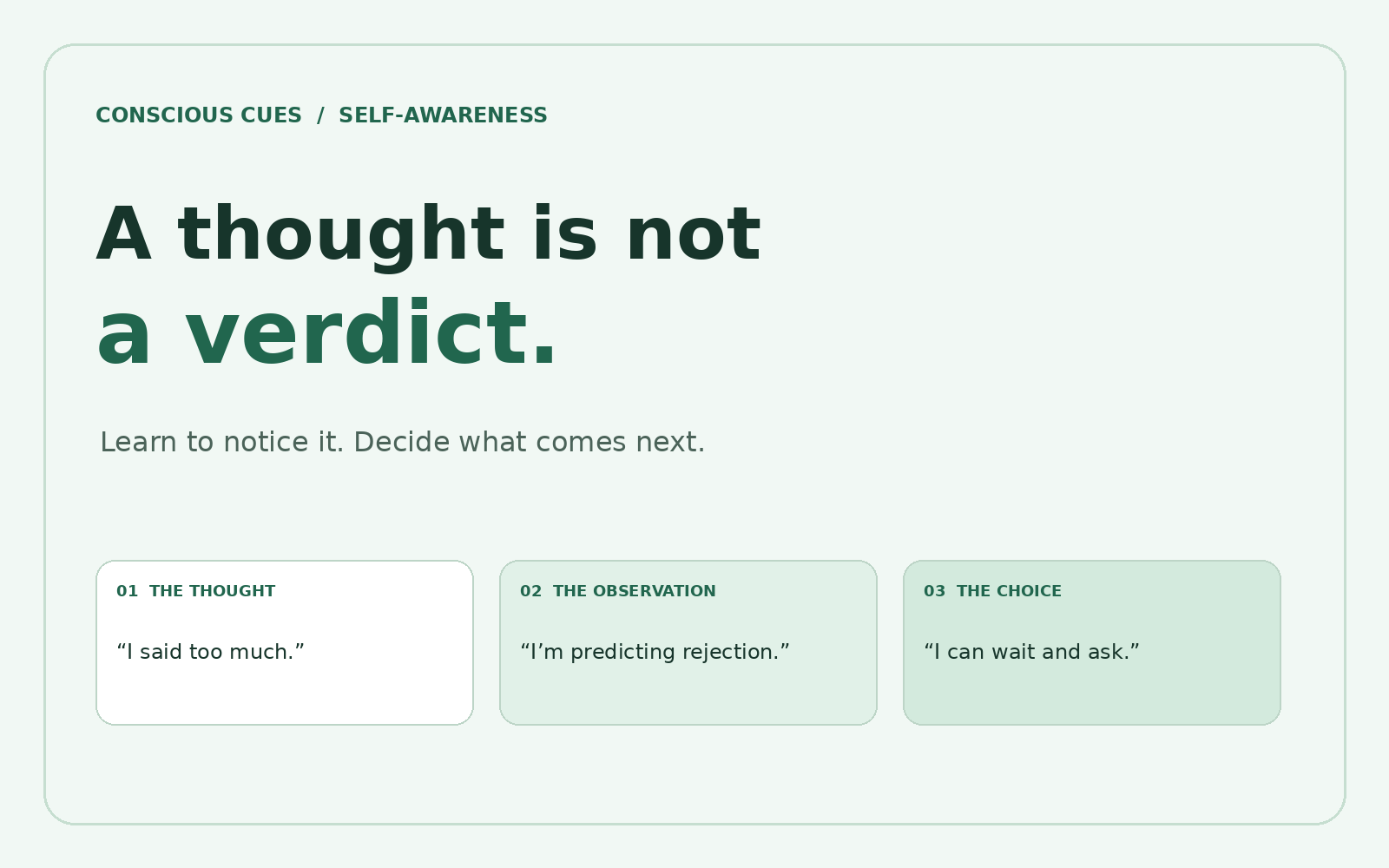
“I said too much.”
“They’re pulling away.”
“I always care more.”
You open the conversation again. Read your last message. Read theirs. Look for the moment the tone changed. Your chest tightens. You begin drafting something casual enough to hide how unsettled you feel.
The unanswered message is still the only new information. But you are now responding to an entire explanation of what it means.
This is one way a thought starts to feel like truth: the interpretation arrives so quickly that you barely notice it is an interpretation.
Learning to notice that moment can change what happens next. You might still feel worried. You might still want clarity. But you have a chance to ask, “What do I actually know?” before sending a message you do not mean, withdrawing from someone you care about, or spending the evening putting yourself on trial.
This guide is about building that chance.
You will learn to recognize a thought as something happening in your mind, examine it when examination is useful, and decide how to respond. “Becoming the witness” means practicing this observing perspective while staying involved in your life.
Start with an everyday situation that feels manageable. You do not need to begin with your most painful memory or most frightening thought. This is educational self-help, not an assessment or a substitute for individual care. If the exercises leave you feeling unreal, detached, or more overwhelmed, stop looking inward and reconnect with your surroundings. Support from a qualified mental health professional can help you adapt the practice.
The people and stories in this guide are fictional teaching examples. The six-step sequence and practice plan are an educational synthesis, not a separately validated treatment protocol.
What it means to treat a thought as a thought
Consider the difference between these sentences:
“I am going to embarrass myself.”
“I’m predicting that I’ll embarrass myself.”
The first sentence puts you inside an outcome that has not happened. The second identifies what your mind is doing: predicting.
You have not proved that the presentation will go well. You have simply stopped calling a prediction a fact.
A thought can contain useful information. It can also contain a guess, an old rule, an unfair judgment, or a mixture of all three. The task is to give it the amount of authority the evidence supports.
“I missed the deadline” describes an event.
“I’m unreliable” turns that event into an identity.
“I need a better reminder system” points toward something you can change.
Those sentences can appear in the same minute. They do very different jobs.
Three skills that often get bundled together
Observing: recognizing that thinking is happening. “There’s the thought that I’ve disappointed everyone.”
Cognitive defusion: loosening the thought’s grip so you have more choice about how to respond. You can carry a thought without following its instruction. This is a skill used in acceptance and commitment therapy, often called ACT. [1]
Cognitive restructuring: examining a thought’s evidence and developing a more accurate interpretation. A thought record is one structured way to practice this in cognitive behavioral therapy, or CBT. [2]
You can use these skills together. You can also notice a familiar thought, decide it needs no further investigation, and return to what you were doing.
You do not have to complete a long mental checklist every time a thought appears. Start by recognizing what your mind is saying. Then choose whether this moment calls for a question, a pause, or a practical response.
What “the witness” looks like in an ordinary moment
Imagine you are in a meeting and someone challenges your suggestion.
Your face gets hot. You think, “They think I’m incompetent.” You want to explain everything immediately.
An observing response might sound like this:
“My face is hot. I’m having the thought that I look incompetent. I want to defend myself. I can ask which part they disagree with.”
You remain in the meeting. You can hear the other person. You notice your reaction without handing it the microphone for the rest of the conversation.
That is enough. You do not need to imagine a separate person watching you or find a perfectly silent place inside your head. “The witness” is a useful metaphor for your ability to notice an experience as you are having it. It is not a claim about what consciousness ultimately is.
You can be the person feeling embarrassed and the person noticing embarrassment at the same time.
Distance should help you participate
Ask yourself, “Does this practice help me be more present and able to choose?”
If you can feel your feet, follow the conversation, and respond more deliberately, the distance may be useful.
If you feel far away from your body, numb, unreal, or as though your life belongs to someone else, stop the exercise. Keep your eyes open. Name where you are. Look at a familiar object or speak with someone you trust. You do not need to push through detachment to become better at awareness.
Before you question anything, separate what happened from what it means
Here is a simple distinction to keep beside you throughout the guide.
| Part of the experience | Example |
|---|---|
| Observable event | My friend canceled our plans today. |
| Interpretation | I am not important to them. |
| Emotion | Hurt, disappointment, fear. |
| Body sensation | Heaviness in my chest. |
| Urge | Cancel next time before they can. |
| Possible need | Reliability, connection, clarity about our plans. |
Your hurt does not need a courtroom verdict before you can care for it. At the same time, hurt alone cannot tell you everything about your friend’s intentions.
There may also be a genuine pattern: perhaps this is the fifth last-minute cancellation. Then the evidence deserves attention. You can question “I’m unimportant” while still saying, “These plans have become too unreliable for me.”
A useful distinction: feeling rejected is an experience. Knowing that someone intends to reject you is a conclusion requiring more information.
Try it with a recent situation:
- What could another person have seen or heard?
- What meaning did I add?
- What feeling and urge followed?
Keep the first answer specific. “They disrespected me” is already an interpretation. “They interrupted me three times while I explained my decision” gives you something concrete to work with.
The six-step practice: from an automatic thought to a chosen response
You can work through this on paper over several minutes. With familiarity, you may use only the parts you need.
Step 1: Catch the sentence your mind is treating as settled
Begin with the exact words, even if they sound unreasonable when written down.
“Everyone is tired of me.”
“If I rest, I’ll fall behind.”
“I ruined the whole conversation.”
Avoid starting with a broad topic such as “my anxiety” or “my relationship.” Find one claim inside it.
If there are no words, notice the image or implication. You might see yourself standing alone at an event. The implied claim could be, “Nobody will want to talk to me.”
Try this: complete the sentence, “The thought I’m caught in right now is…”
Then ask what it is prompting you to do. Refresh the inbox? Apologize? Quit? Keep working through exhaustion? This helps you see why the thought matters in this situation.
Example: Leo sees a friend’s holiday photographs and feels suddenly behind in life. After writing for a minute, he identifies the sentence: “At my age, I should have more to show for myself.” The photographs are the trigger. The rule about his age is what he can examine.
You do not need to catch every thought. Begin with one that is pushing you toward a response you want to reconsider.
Step 2: Name the mental activity without insulting yourself
Put a short description around the thought.
“I’m predicting rejection.”
“I’m replaying yesterday’s conversation.”
“I’m turning one mistake into a judgment about my character.”
“I’m trying to work out what someone else thinks.”
The description should help you recognize the process. You do not need the correct technical label.
If “catastrophizing” makes sense to you, use it. If it makes you feel defective or sends you searching for a diagnosis, “my mind has jumped to the worst outcome” may be more useful.
Try this: add “I’m noticing the thought that…” before the original sentence.
“I’m noticing the thought that I ruined the whole conversation.”
Say it once at an ordinary pace. Check whether it gives you any room to breathe or choose. If the wording feels cumbersome, shorten it: “There’s that prediction again.”
Repeating the phrase until you feel certain or calm can become another demand. The phrase is a reminder, not a password that must be said correctly.
Step 3: Notice the feeling and reconnect with where you are
Before analyzing the thought, check whether you have enough attention available to examine it.
You might be pacing, gripping your phone, or rereading a sentence without taking it in. If so, start with your surroundings.
Try resting your hands on a surface. Look around and identify a few ordinary objects. Notice the support of the chair or the floor. Let your breathing stay comfortable rather than forcing a deep breath.
If attention inside your body is uncomfortable, stay with external details: the color of the door, the sound of a fan, the texture of an object in your hand. WHO’s stress-management guide includes grounding and noticing practices alongside learning to unhook from thoughts. [3]
Then name the feeling as well as you can:
“I’m worried and embarrassed.”
“I feel angry, and I want an answer immediately.”
“I’m disappointed. I need a moment before deciding what this means.”
You can also distinguish the physical detail from the emotion: “My jaw is tight, I feel angry, and I want to reply immediately.” Try one comfortable adjustment, such as putting the phone down or resting your hands on a surface. Check whether that gives you more room to choose. You do not need to become completely calm before examining the situation.
The feeling may remain. You are checking whether you can engage with the situation without being completely absorbed by it.
Example: Before replying to a critical email, Amina puts the phone down and looks out the window. She notices that she is holding her jaw tight. She does not try to erase her anger. She waits until she can read the email once without composing an argument over every line.
If you cannot get there right now, postpone the analysis. Eat if you need food. Take a break. Contact a supportive person. You can return to the question later.
Step 4: Ask the question that fits the kind of thought
Different thoughts need different responses.
| If the thought is… | A useful question might be… |
|---|---|
| A prediction | What information supports this outcome, and what remains unknown? |
| A guess about another person | What did they actually say or do? Could I ask for clarification? |
| A global self-judgment | What specific action or skill am I evaluating? |
| A rigid rule | Where did this rule come from, and what does following it cost? |
| A practical problem | What action would help, and when can I take it? |
| A familiar uncertainty with no new information | Is more analysis adding anything useful? |
Choose one or two questions. You are looking for a better basis for action, not attempting to eliminate every possible doubt.
For a claim you can examine, write down evidence supporting it and evidence that limits or contradicts it. The NHS thought-record exercise uses this approach to help develop a more realistic or neutral interpretation. [2]
Original claim: “My manager thinks I’m bad at my job.”
Information supporting concern: They returned the report with several requested changes.
Information limiting the conclusion: They have not said my overall work is poor. They asked me to lead the next meeting. Some revisions concern requirements that changed after I wrote the draft.
What remains unknown: Whether they are concerned about my performance more broadly.
Possible next step: Ask which revisions matter most and whether there is a wider concern I should address.
You might still discover that your manager is unhappy. Questioning the thought prepares you to respond to the actual feedback instead of a much larger imagined verdict.
Step 5: Write a response you can honestly stand behind
You do not have to replace a painful thought with its opposite.
If your original thought is “I’ll never manage this,” “I am unstoppable” may feel like something you would print on a mug and immediately put in the cupboard.
Try a sentence that stays close to the situation:
“I don’t know how to do all of this yet. I can learn the first part.”
“This conversation went badly. I can take responsibility for what I said without deciding that I ruin every relationship.”
“I want them to like me. Their response will give me information, but it cannot establish my worth.”
“This situation is genuinely uncertain. I can decide what I need while I wait.”
Try this structure: “What I know is ____. What I’m assuming is ____. A fairer way to describe this is ____.”
If you cannot produce a balanced sentence, use a modest one: “I may be missing some information.” Or, “I do not need to settle this tonight.”
You are allowed to leave the question open.
Step 6: Choose a response that fits your priorities
Ask, “Given what I know, what do I want to do next?”
The answer should be an action you can describe: request clarification, correct an error, leave the phone alone while making dinner, set a boundary, prepare for an appointment, or complete ten minutes of a task.
“Stop being insecure” is not an action. “Ask whether we are still meeting on Friday” is.
“Believe in myself” may be a long-term hope. “Submit the application after checking the requirements once” is a next step.
You can take that step while the original thought is still present. The VA’s description of defusion emphasizes changing your relationship with thoughts so you can respond more flexibly and act according to your priorities. [1]
The practical test: did noticing the thought give you more choice about your behavior? Immediate calm is not required.
Why your mind can give the negative possibility so much attention
You receive five encouraging comments about your work and one criticism. On the way home, the criticism is the comment you keep revisiting.
Or you have a good afternoon with someone, then notice a brief change in their expression. Later, that expression becomes the evidence you use to evaluate the entire afternoon.
These are everyday examples of what negativity bias can look like: negative information can receive more weight than similarly strong positive information. In a laboratory study, researchers found larger electrical brain responses to negative than to comparably intense positive pictures during an evaluation task. [4] That finding does not mean every person always notices negative information first.
A study of responses to video news across seventeen countries also found stronger physiological responses to negative news on average, alongside considerable differences between individuals. [5] Negativity bias describes a tendency found in research, not a rule that explains every difficult thought.
Attention is not a verdict on accuracy
In the examples above, a criticism or uncertain expression becomes very prominent. It is easy to move from “I keep noticing this” to “This must be the most important information.”
But those are different claims. Something can hold your attention without giving you a complete account of what happened.
Try asking, “If I described the entire interaction, what else would belong in the account?”
Perhaps the criticism identifies a genuine improvement you need to make. Include it. Also include the parts that worked. Perhaps the expression signals discomfort. You can remain curious about it while remembering the rest of the conversation.
This is an exercise in giving the available information a fair hearing.
Story: one comment that swallowed the rest of the evening
After facilitating a workshop, Elena receives several specific comments about what participants found useful. One person says the opening felt rushed.
That evening, her mind keeps returning to the same sentence: “The opening felt rushed.” Soon it becomes, “The workshop was disappointing.” Then, “I’m not good at this.”
Elena writes down the actual feedback. The opening needs more time. Participants also described exercises they understood and wanted to use again. Nobody gave her the global verdict she has been repeating to herself.
Her response is practical: shorten the opening explanation next time, allow more time for questions, and keep the exercises people found useful.
Later, the criticism returns to mind. She notices, “I’m treating one part as the whole again.” She does not need to reread every positive comment until she feels reassured. She has already identified what to change.
Why “your brain is trying to protect you” needs some nuance
Attention to possible danger can be useful. A threatening possibility may deserve a prompt response. But we cannot identify the origin or purpose of a particular thought simply because it sounds alarming.
For this practice, you do not need a story about an ancient survival brain. Ask what the thought is doing in the situation you are in: is it pointing to evidence you should act on, or repeatedly presenting a possibility you have already considered?
You can acknowledge why a concern matters without assuming its conclusion is correct.
A practice for noticing the information you leave out
After a situation you keep replaying, write three short entries:
- What was difficult or concerning? Describe it without minimizing it.
- What else happened? Include neutral details and anything useful, supportive, or enjoyable.
- What response does the full account suggest? Consider whether it calls for repair, preparation, a boundary, or no further action.
You do not need a fixed ratio of positive to negative observations. You are not required to feel grateful for something painful. The purpose is to check whether your account has become narrower than the evidence.
What happens when you notice your mind wandering
When you are absorbed in a thought, noticing that you are thinking involves a shift in awareness. Researchers sometimes call awareness of your own current mental activity meta-awareness.
In research on focused-attention meditation, Hasenkamp and colleagues described a cycle of mind-wandering, noticing that wandering, redirecting attention, and sustaining focus again. [6]
Their related brain-imaging work associated mind-wandering with default-mode regions, awareness of wandering with salience-network regions, and redirecting or sustaining attention with executive-network regions. These are interacting networks, not separate characters inside your head. Default-mode activity also supports ordinary mental life, including remembering and thinking about yourself. [7]
The useful lesson is modest: being caught in a thought and noticing that thought involve distinguishable mental processes. Brain imaging does not establish a single “witness center,” prove a spiritual account of consciousness, or reveal whether a particular thought is true.
What people mean when they say meditation changes the brain
Learning can involve changes in how the brain works. That broad idea does not tell us exactly what a specific meditation exercise will do for a particular person.
NCCIH notes that studies have reported differences in brain function or structure associated with meditation, but the findings are difficult to interpret and their practical implications remain unclear. [8] Comparing experienced meditators with beginners also cannot, by itself, establish that meditation caused every observed difference.
You do not need a promise about brain scans to decide whether a practice is useful. Look for changes you can observe in daily life: recognizing a familiar judgment, returning to a conversation, or choosing to ask a question before reacting to an assumption.
Building the witnessing muscle through meditation
“Muscle” is a metaphor here. You are practicing a skill: recognizing where your attention has gone and choosing how to respond.
During a simple meditation, you choose something to attend to. Your attention moves. At some point you realize it has moved. You return to your chosen focus.
That return is an opportunity to practice the same move you need in an everyday spiral:
“I was absorbed in the story. I can notice it now. Where do I want to place my attention?”
You can practice with a neutral distraction before trying it with an emotionally charged thought. Remembering your shopping list is enough material for a beginner session.
The moment you notice wandering is part of the practice
Suppose you sit down to attend to sounds in the room. A minute later, you realize you have been mentally composing an email.
Your first response might be, “I can’t meditate.”
Notice that this is a second thought layered on top of the email planning. You can recognize both: “Planning an email. Now judging the session.” Then return to listening.
You do not need to congratulate yourself enthusiastically. A simple “noticed” can be enough. You are rehearsing a response that does not add a punishment every time attention moves.
There may be sessions with frequent wandering and sessions with longer stretches of focus. Neither gives you a complete score for your ability to handle life.
A beginner practice: three minutes of noticing and returning
This is an optional exercise, not a required dose. Try less time if that suits you. Choose a place where you can pause safely, away from driving or another task that needs your full attention.
1. Choose a comfortable position and look around.
Sit, stand, or use a supported position. Let yourself register where you are. Keep your eyes open if that feels better.
2. Pick an anchor you can return to.
An anchor is a chosen focus. It might be the sound of a fan, the contact of your feet with the floor, or the feeling of an ordinary breath. Choose an external anchor if attention to breathing or body sensations is uncomfortable. You can change anchors.
3. Attend to one ordinary detail.
Hear the sound as it changes, feel the contact with the floor, or notice the breath without making it deeper. You do not need to concentrate as hard as possible.
4. When you realize you are thinking, acknowledge it briefly.
“Planning.” “Remembering.” “Evaluating.” Or simply, “Thinking.” You can skip the label if it creates more effort than it helps.
5. Return to the anchor without finishing the thought.
You can leave the imaginary email unfinished. You can notice an urge to continue it and still listen to the next sound. If the thought contains something you genuinely need to remember, you may make a brief note and resume, or end the session and address it.
6. Finish deliberately.
Look around, notice the room, and choose your next activity. Ask, “Was there a moment when I recognized that I was thinking?” You do not need to count every return or grade the session.
If distress builds, stop. Open your eyes if they are closed, move, or connect with someone. Meditation can have unwanted effects for some people, and pushing through distress is not a requirement for learning awareness. [8]
What you might notice during those three minutes
| Experience | A possible response |
|---|---|
| “This is boring.” | Recognize the evaluation. Listen to the next sound, or choose a shorter practice. |
| “Am I doing it correctly?” | Notice the checking question. Return to one simple detail without trying to settle it perfectly. |
| You plan dinner for most of the session. | Acknowledge that you noticed. Resume for the remaining time if you want to. |
| You feel an urge to check your phone. | Notice the urge and decide whether to stay for another moment. You do not have to obey it immediately. |
| A difficult memory appears. | You can end the practice and orient to the room. The memory does not have to become the session’s focus. |
| You feel calm. | Enjoy it if you like. A future session may feel different. |
Focused attention and open awareness offer different practice opportunities
With focused attention, you choose an anchor and return to it. This gives a beginner a clear task.
With open awareness, you allow attention to notice experiences as they arise: a sound, a sensation, a thought, a feeling. You practice recognizing them without deliberately developing each one into a story.
For example: hear traffic, notice a thought about being late, feel your hand resting on your leg, then hear the traffic again. You do not need to search for more things to notice.
If open awareness turns into following every thought or makes you feel ungrounded, return to one external anchor or stop. It is an option, not a level you have to reach.
Story: “I could only think about my to-do list”
Omar tries a short practice after making coffee. He chooses to listen to sounds outside his window.
Almost immediately, he starts planning his day. When he notices, he thinks the practice has gone wrong. He checks the timer and sees that only a minute has passed.
The next morning, he changes what he is asking of the session. Whenever he recognizes planning, he returns to a sound without requiring the plan to disappear.
By the end of the week, some sessions still feel busy. One afternoon, however, he notices himself mentally preparing a rebuttal while a colleague is speaking. He recognizes the familiar planning process and returns to listening. He hears a detail that changes how he answers.
This fictional example illustrates the kind of transfer the practice is intended to support. A quiet session would not automatically guarantee that change; Omar still has to use the skill in the conversation.
Taking the practice into moments that actually matter
Choose one ordinary cue in your day rather than trying to watch your mind continuously.
Before opening your messages: notice whether you are already predicting what you will find. Read what is actually there before deciding what it means.
When receiving feedback: notice the first global judgment. Ask for the specific change the person is requesting.
During a disagreement: recognize when you are rehearsing an answer instead of hearing the current sentence. Return to the speaker, provided the conversation is safe enough to continue.
Before abandoning a task: notice whether the thought is “I need more information,” “I’m tired,” or “I must do this perfectly.” Those point toward different next steps.
After a pleasant moment: give yourself a moment to register what was actually enjoyable. You do not need to use it to cancel something difficult. Both belong in your account of the day.
Start with a situation where you have some room to experiment. You do not have to practice first in your hardest relationship or most activating conversation.
What progress can look like
You might notice the thought sooner. You might notice it at the same point but recover from the reaction more readily. You might still feel the full emotion and choose a less impulsive response.
For example, you may continue to feel anxious after a delayed reply, but stop sending an apology for something you do not believe was wrong. You may remain embarrassed about a mistake while correcting it promptly. You may recognize a spiral only after it has happened, then repair the conversation instead of condemning yourself for the entire day.
These are useful observations to track. The absence of thoughts, discomfort, or conflict would be a much less practical standard.
How often should you practice?
Try a short session at a time you are likely to remember, such as after breakfast. Pair it with one everyday opportunity to notice and choose. The three-minute exercise is a manageable starting experiment, not a scientifically established minimum or a promise of results.
Extend the time only if you find it useful and tolerable. A guided recording, a walking practice with attention to your surroundings, or support from a suitably trained instructor may suit you better than sitting in silence. Longer sessions are not automatically more appropriate.
If you repeatedly become more anxious, detached, or preoccupied through practice, adjust or stop and seek individual guidance. The aim is to become more able to participate in your life.
Include your body in what you notice
You might recognize a thought before you notice the physical reaction around it. Or your first clue might be your shoulders lifting, your stomach tightening, or your hand reaching for the phone again.
Somatic awareness means including that physical experience in what you notice. You do not have to translate every sensation into a message or find a hidden cause. You can start with an ordinary description: “My jaw is tight. I’m leaning forward. I want to answer immediately.”
Now you have more of the situation available to you. Alongside the thought “I have to explain myself,” you can notice the urge to rush and decide whether you need a pause.
Separate the sensation from the explanation
“My stomach feels tight” describes a sensation.
“I feel afraid” names an emotional experience.
“Something bad is definitely going to happen” predicts an outcome.
All three may arrive together. They are still different kinds of information.
A sensation is real as an experience. Its presence alone does not establish its cause or prove a conclusion about another person. You can feel a strong reaction and still ask what is happening around you. Equally, you do not need a strong reaction before you are allowed to recognize disrespect or protect a boundary.
Try: “I notice ____. The explanation my mind is adding is ____. What else do I need to consider?”
For example: “I notice a tight chest before this call. My mind says I’m about to be criticized. I haven’t heard what the person wants to discuss.”
New, severe, or concerning physical symptoms deserve appropriate medical attention. Do not assume that a symptom is caused by thoughts or try to meditate through a possible medical problem.
You can work with the experience before deciding what it means
Suppose you are gripping your phone while reading an upsetting message. You can put the phone on the table. Notice the room. Shift into a more comfortable position. Decide whether to read the message again now or take a break.
Those are small physical choices available before you settle the argument in your head. They may or may not change how you feel. Their immediate purpose is to give you a way to pause and participate more deliberately.
WHO’s grounding exercises similarly combine noticing difficult experiences, reconnecting with the body, and engaging with the surrounding world. Grounding does not require difficult thoughts or feelings to disappear. [3]
A short practice: notice, find support, choose
Use this with an everyday reaction that feels manageable. Keep your eyes open if you prefer. You can skip internal sensations entirely and work with your surroundings.
Notice one detail. Perhaps your hands are clenched, your feet are moving, or your back is uncomfortable. Describe what you can actually sense. Avoid turning “tight shoulders” into a diagnosis of your nervous system.
Notice an urge, if there is one. Do you want to explain, withdraw, scroll, argue, or leave? “I want to send another message” is an observation. You have not committed to sending it.
Find an available point of support. Try the chair beneath you, your feet on the floor, or your hands resting on a table. If none of those feels useful, look at a familiar object or listen to an ordinary sound.
Make one comfortable adjustment. You might put down an object, uncross your legs, change position, or take a few unhurried steps if that is accessible. Self-touch is optional. Leave your breathing natural; you do not have to take a deep breath or hold it.
Return to the situation. Ask, “What do I know, and what response fits?” You can choose a boundary or practical action while some tension remains.
Stop if the exercise increases distress, dizziness, or detachment. You are not trying to provoke a release, force a sensation to change, or endure an uncomfortable position.
Choose an entry point that fits this moment
| What you notice | An option to try |
|---|---|
| You are rushing to respond. | Put down the phone or step away from the keyboard before choosing your words. |
| You have been sitting rigidly and replaying the conversation. | Change position or walk briefly, then decide whether any new information needs attention. |
| You feel dull, distant, or unable to follow your thoughts. | Keep your eyes open, orient to the room, or connect with a trusted person. Skip inward meditation. |
| Attention to breathing makes you more anxious. | Choose sound, sight, or contact with an external object instead. |
| You feel an intense urge to apologize. | Notice the urge, then ask whether you did something that calls for an apology. |
| You feel calm but see a repeated harmful pattern. | Take the pattern seriously. Calmness does not make harmful behavior acceptable. |
These are options, not a system for classifying your body into fixed states. You can try one, see whether it helps you engage, and change course.
Story: the boundary she understood but struggled to say
When Maya prepares to tell her family member she cannot lend money again, she already knows the amount is beyond her budget. Yet as she picks up the phone, her throat feels tight. She rehearses explanations and considers offering money she needs for rent.
She notices, “I feel tension in my throat, and I want to talk until they agree with me.” She rests the phone on the table and reads the sentence she prepared: “I’m not able to lend you money.”
The tension does not disappear. She decides she can say the sentence slowly and pause afterward. If the conversation becomes abusive, she can end it.
The somatic part of the practice helps her recognize what is happening as she tries to act. It does not tell her whether the boundary is justified; her finances and the lending pattern inform that decision.
Feeling something without obeying every urge
An urge can be present without becoming your next action. You might feel the pull to retreat after receiving feedback, while choosing to ask one clarifying question. You might want to continue an argument, while deciding to say when you will return to the discussion.
Sometimes the appropriate response is to leave, seek help, or act immediately on a real concern. Witnessing is not an instruction to remain still or tolerate everything. Ask what the circumstances call for.
Do not turn body awareness into constant checking
You do not need to inspect your heartbeat, breathing, or muscle tension throughout the day. If checking sensations becomes repetitive or makes you more worried, shift attention outward and return to an ordinary activity. Seek individual guidance if that pattern persists.
One brief observation is enough to begin: “I’m gripping the phone.” Then choose what to do with that information. You can build awareness without making your body another problem to monitor.
Story: the unanswered message that became a relationship verdict
Nina has been seeing someone for a month. They usually exchange a few messages during the day. On Thursday, she sends a voice note about something personal. By evening, there is no reply.
She thinks, “I was too much. They’ve lost interest.”
She begins writing, “Sorry, that was a lot. You don’t need to listen.” Then she deletes it and drafts something colder: “Never mind.”
Before sending either, she writes the situation down.
What happened: I sent a voice note this morning and have not received a reply.
What I added: Sharing something personal made them lose interest.
What I feel: Exposed and worried.
What I want to do: Apologize for sharing or pull away first.
What I notice physically: My hands keep reaching for the phone. My shoulders are lifted. I can put the phone down and change position while deciding what to do.
What I know about the pattern: They have generally followed through on plans. Today is unusually quiet. We have not discussed what messaging frequency either of us expects.
Nina cannot prove that everything is fine. She can see that she is about to apologize for being personal without knowing whether that caused a problem.
Her more accurate response is: “The silence is uncomfortable. I don’t yet know what it means. I can see how they respond and ask for clarity if this becomes a pattern.”
She puts the phone away while she eats. The worry returns several times. Each time, she says, “I’m filling in the silence again,” and returns to what she is doing.
Later, the person replies. In this version of the story, they had a difficult day at work. But the practice would still matter if they were losing interest. Nina would be able to respond to that information without treating it as proof that sharing herself was a mistake.
Try the same distinction: What uncertainty am I trying to solve by criticizing myself?
Story: a real mistake without a lifelong sentence
Daniel sends a client a document containing an incorrect figure. The client points it out.
He thinks, “I’m incompetent. It’s only a matter of time before everyone notices.”
There is a real mistake here. He does not need to convince himself that the document was fine. He needs to correct it.
Daniel separates two questions:
“What happened, and what repair is needed?”
“What am I deciding this says about me?”
He checks the source, corrects the figure, and tells the client exactly what changed. He adds a check to the part of his workflow where the error occurred.
Then he addresses the identity claim: “I made an error that affected the client. I am responsible for correcting it. This one error does not describe all of my work.”
He still feels embarrassed. He finishes the correction anyway.
A week later, he notices the thought again while checking another report. This time it pushes him to reread the entire document for the sixth time. He asks whether another full review is likely to catch something new or whether he is trying to obtain a feeling of certainty. He completes his normal checks and sends it.
Try this distinction: Which part of my response improves the work, and which part only extends my punishment?
Story: questioning self-blame while keeping a boundary
Maya tells a family member she cannot lend them money again. They reply, “You only ever think about yourself.”
Her immediate thought is, “Maybe I’m selfish. A good person would help.”
She has lent money several times. Some has not been repaid. This month she needs the money for her own rent.
If Maya uses thought work to make herself more comfortable saying yes, she misses the actual issue. Her distress does not automatically mean her boundary is wrong.
She examines the rule: “To be a good person, I must give what someone asks, even when I cannot afford it.”
She asks where that rule would leave her if she applied it consistently. She also asks whether she would expect a friend to risk their housing to avoid disappointing someone.
Her response becomes: “I care about them. I cannot provide this money. Their disappointment does not decide whether my limit is reasonable.”
She replies, “I understand you’re disappointed. I’m not able to lend you money.” She does not add a long defense of her character.
Try this distinction: Am I questioning an unfair judgment about myself, or questioning my right to protect a reasonable limit?
Story: “I’m behind” in a room full of other people’s milestones
At a dinner, Sam listens to friends discuss promotions, children, and buying homes. He is renting, changing careers, and unsure where he wants to live.
He becomes quiet. His thought is, “I’ve wasted my life.”
On the way home, he notices how large the sentence is. “My life” includes years of relationships, work, care, mistakes, learning, and ordinary days. The dinner has become a verdict on all of it.
He gets more specific: “I want more financial stability. I’m disappointed that my career change is taking longer than I hoped. I’m comparing my uncertainty with the parts of my friends’ lives they discussed tonight.”
Some sadness remains. But the specific statement allows a useful question: “What would make my finances a little more stable over the next three months?”
He writes down one person to contact about work and a time to review his expenses. He also notices that he wants more community. Buying a house would not automatically answer that need.
Try this distinction: What particular desire is hiding inside my global judgment?
More examples: what to notice, question, and do
Use these as examples of reasoning, not replacement sentences you have to believe.
“They seem quiet. I must have upset them.”
You have noticed a change in behavior and supplied a cause. Ask whether you have evidence linking the quietness to you. If appropriate, say, “You seem quieter today. Is there something you want to talk about?” Let their answer add information instead of interrogating their tone for an hour.
“If I feel anxious, something must be wrong.”
Notice the anxiety, then check the situation separately. Is there an immediate hazard, a specific problem, or an uncertain outcome? A feeling deserves attention, but its intensity does not establish the likelihood of every feared event. Respond to an actual hazard. If there is no identified hazard, consider a small action you can take while allowing some uncertainty.
“I should be over this grief by now.”
Identify the deadline inside “should.” Who set it? What changes when you replace the judgment with “I’m grieving today”? You might still want more support or find daily life difficult. Those are reasons to seek care, not proof that you have failed at grieving.
“I’m a terrible parent.”
Bring the claim back to an event: “I shouted when I was overwhelmed.” Then consider repair: “I raised my voice. That wasn’t okay. I’m sorry.” If it is recurring, examine what support and changes are needed. Responsibility becomes more useful when it describes behavior you can address.
“If I say no, they’ll leave.”
Ask whether this person has threatened you, repeatedly punished boundaries, or generally respected limits. Your response depends on the evidence. You might practice a small refusal in a respectful relationship. If there is coercion or danger, prioritize safety and support rather than using a confrontation as a thought experiment.
“Everyone noticed how awkward I was.”
“Everyone” is doing a lot of work in that sentence. What did you observe? Perhaps you lost your place and one person looked confused. You can acknowledge that moment without inventing the private evaluation of the entire room. If useful, ask a trusted person for specific feedback once.
“If I rest, I’m lazy.”
Look at the rule connecting worth with continuous output. What happens to your work and life when you follow it? You can test a reasonable rest period and observe how you function afterward. You do not need to earn basic care by reaching exhaustion.
“This symptom means something terrible.”
Write down the symptom separately from the diagnosis you fear. Seek appropriate medical assessment, especially for new, severe, or concerning symptoms. Thought work cannot determine a diagnosis or make an urgent symptom safe. It can help you prepare questions and follow a care plan without treating every alarming possibility as an established result.
“I failed once, so trying again would be embarrassing.”
Ask what the first attempt tells you about the next one. Is there a skill to practice, a requirement to check, or a reason to change direction? Choose a next attempt proportionate to the situation. You can feel embarrassed and still send a revised proposal.
“If I have this thought, it must say something terrible about me.”
An unwanted mental event does not by itself establish your character, intention, or what you will do. You do not have to inspect every thought for a hidden verdict. If frightening thoughts lead to repeated checking, reassurance-seeking, or avoidance, seek professional guidance rather than expanding your private investigation. If you feel at risk of acting on a harmful urge, seek urgent help.
“I don’t feel confident, so I’m not ready.”
Check readiness against the actual task. Do you meet the requirements? Have you practiced enough for a reasonable first attempt? You may need preparation. You may also be waiting for a feeling that is not required to begin. Let the task’s demands help you decide.
“I did well, but it doesn’t count.”
Notice whether the criteria change after you succeed. Before the task, finishing mattered. Afterward, you decide it was too easy to matter. Record what you actually did and what it required. You can recognize a contribution without making a grand claim about yourself.
When the thought is partly or completely true
Sometimes they are disappointed. Sometimes you are underprepared. Sometimes the relationship is ending.
Observing thoughts should help you face those situations with more accuracy.
Suppose the thought is, “I cannot afford this apartment.” You review your finances and the numbers support it. A useful response is to revise the budget, negotiate, or look elsewhere. Reframing cannot increase your income by changing the wording.
Now suppose the thought continues: “So I’m a failure and I’ll never be secure.” Those are additional conclusions. You can take the financial problem seriously without accepting the identity judgment or lifelong prediction.
Try separating:
- The part I need to acknowledge: What is actually happening?
- The meaning I am adding: What does my mind say this proves?
- The response available to me: What help, decision, or action fits the real problem?
An accurate thought can still be repeated long after it has provided useful information. “That relationship ended” may be true. Rehearsing it for another hour may not help you decide what to do with tonight.
How to question a thought without invalidating yourself
You can say, “That hurt,” before deciding why the other person behaved as they did.
You can say, “I’m frightened,” without declaring the feared outcome inevitable.
You can say, “This pattern is unacceptable to me,” even when you cannot prove someone’s intent.
Thought work becomes invalidating when you use it to make yourself tolerate something you already have enough information to address.
If someone repeatedly insults you, you do not need to determine whether they secretly respect you. You can respond to the insults. If you have experienced discrimination, do not automatically classify your interpretation as a thinking error. Consider context, patterns, and support from people equipped to understand the situation.
One useful question is: “Am I making my account more accurate, or making it easier for someone else to dismiss?”
Accuracy includes the possibility that your concern is justified.
Questioning can turn into another form of overthinking
Here is the difference in a fictional example.
Useful reflection: “I’m worried I upset my friend. I’ll review what happened once, decide whether an apology is warranted, and ask if something needs clearing up.”
A loop: “But what if the apology sounded manipulative? What if their answer was just politeness? What if I missed a facial expression? Let me review it again.”
The second process keeps moving the finish line. No answer is allowed to remain sufficient.
You may be in a loop when you repeat the same questions without new information, feel compelled to obtain complete certainty, or postpone ordinary life until your analysis feels finished.
Try a boundary around reflection:
“I’ll give this a short written review. Then I’ll choose an action or leave the uncertainty unresolved for now.”
If the same question returns, you can answer, “There is no new information. I’ve chosen what to do next.” Return attention to an actual activity. This may feel unfinished. An unfinished feeling is not always an unfinished task.
If you have OCD or suspect that checking and mental reviewing have become compulsive, repeated evidence-testing can become part of the problem. Seek guidance from a clinician familiar with OCD rather than using this guide as a reassurance routine.
A short witnessing practice you can use with your eyes open
Try this for about a minute, or less if that is enough. Skip it if inward attention makes you feel detached.
Sit or stand somewhere reasonably comfortable. Look at an ordinary object in the room.
Notice that you can see the object and also hear sounds around you.
If a thought appears, describe it briefly: “Planning.” “Remembering.” “Wondering whether I’m doing this right.”
Let the thought stay or move on in its own time. Bring some attention back to the object.
If you notice a feeling, you might say, “There’s some frustration here.” If you prefer, simply notice your hands touching a surface.
Finish by choosing what you will do next. Stand up, return to your work, drink some water, or speak to someone.
You have practiced moving attention between an internal event and your surroundings. Your mind did not need to become empty. If you spent most of the minute thinking and noticed at the end, that moment of noticing still counts as practice.
Choose one small experiment instead of another hour of debate
Some predictions can be tested through an ordinary, low-risk action.
Prediction: “If I ask a question in class, people will think I’m stupid.”
Possible experiment: Ask one relevant question. Record what people actually do, including neutral responses. You will not gain access to everyone’s private thoughts. You can learn whether asking makes participation more useful and whether the consequences you predicted occur visibly.
Prediction: “If I take a lunch break, I won’t finish anything.”
Possible experiment: Take a reasonable break on a normal workday. Observe your afternoon work and energy. One day will not settle the question permanently, but it can give you more information than repeating the rule.
Prediction: “I cannot write unless I feel inspired.”
Possible experiment: Write an imperfect paragraph for ten minutes. Evaluate whether anything usable emerged. The paragraph does not need to be brilliant to challenge the word “cannot.”
Keep experiments proportionate. Do not test safety by exposing yourself to a threatening person, ignoring medical advice, or creating a serious financial risk. A useful experiment gives you information at an acceptable cost.
A seven-day way to practice without monitoring yourself all day
This is an optional practice schedule. It does not promise a change within seven days. Spend a few minutes with one manageable situation, then return to your day.
| Day | Practice | Example of what to record |
|---|---|---|
| 1 | Catch one exact thought. | “If I ask for help, I’ll look incapable.” |
| 2 | Separate the event from its meaning. | “I received two requested edits. I concluded the work was terrible.” |
| 3 | Name the mental activity once. | “I’m predicting what my colleague thinks.” |
| 4 | Notice feeling and surroundings. | “Embarrassed. Feet on the floor. I can hear the conversation.” |
| 5 | Examine one claim briefly. | “Some work needs revision. I have no evidence the whole project failed.” |
| 6 | Take one appropriate action. | “Ask which revision is the priority.” |
| 7 | Review what gave you more choice. | “The worry stayed, but I asked instead of avoiding the meeting.” |
If you miss a day, continue with the next useful opportunity. Turning awareness into another standard to fail defeats the purpose of the exercise.
A thought-and-body worksheet for a situation you are in now
Optional writing space. Answers are not saved by this guide or submitted to Conscious Cues. They may disappear when you leave or refresh. Avoid sensitive identifying details. You can also use paper.
Choose one recent, manageable event. Write short answers. Leave any prompt blank if it is not useful.
Describe what was said, done, or observed.
Write the sentence, prediction, image, or rule you are reacting to.
Include the emotion and the urge. These may point in different directions.
Use ordinary language: warmth, tension, contact with the chair, hands gripping an object. You do not have to scan your whole body or infer a cause. You may skip this prompt.
Consider a change of position, an external focus, a pause, or contact with a supportive person. Describe what you try without requiring it to remove the feeling.
For example: predicting, comparing, replaying, self-judging, or trying to solve uncertainty.
If not, choose grounding, practical care, or support first.
Use specific events. Include patterns when they are relevant.
Write it as unknown rather than filling it with a guess.
Aim for accuracy. A neutral sentence is enough.
Make it concrete and proportionate.
For example: “Notice it, check whether there is new information, and return to the task if there isn’t.”
You can record whether the feeling changed too. Do not make feeling better the only measure.
You might also note, “My shoulders stayed tense, but I asked a clear question,” or “I became more overwhelmed, so I stopped and sought support.” Both give you useful information about how to adapt the practice.
Questions people often have when they start
If I am not my thoughts, then what am I?
You do not need a final philosophical answer to practice this. The useful distinction is that one mental event cannot describe everything about you. You have a history, relationships, responsibilities, preferences, and the ability to notice and respond. You can examine “I’m worthless” without accepting it as your identity.
Can I trust myself if I question my thoughts?
You can learn to trust your ability to check information and respond, rather than requiring every first impression to be correct. Sometimes your first interpretation will hold up. Sometimes it will change. Both can be part of sound judgment.
What if the thought sounds like my own voice?
It usually will. Familiar wording does not establish accuracy. Ask what the sentence claims and what you know about that claim. You do not need to work out exactly where every thought originated.
What if I understand all this and still believe the thought?
Intellectual understanding may arrive before your reaction changes. Work with the response available to you now. You might still believe “I’ll look foolish” and choose to ask the question anyway. If the thought is persistent or significantly affects your life, individual support can help.
What if the thought comes back immediately?
Recurrence does not mean the exercise failed. Avoid restarting a full investigation by default. Notice whether there is new information or a new decision to make. If there is neither, practice returning to what you chose to do.
Should I do this with every thought?
No. You need ordinary thinking to plan, remember, enjoy things, and solve problems. Constantly monitoring your mind can become exhausting. Use the practice when a thought is narrowing your choices or pushing you toward a response you want to reconsider.
How do I know whether I am avoiding a feeling?
Ask whether you are allowing yourself to acknowledge what hurts. “I feel lonely, and I want connection” stays in contact with the experience. Repeating “It’s just a thought” to shut down loneliness may prevent you from recognizing a real need. Awareness should leave room for feelings and practical needs as well as thoughts.
When is a guide not enough?
Seek professional support when thoughts or associated behaviors are repeatedly disrupting sleep, work, relationships, or daily functioning; when you become more detached through these practices; or when you feel unable to interrupt checking or mental reviewing. If you feel at immediate risk of harming yourself or someone else, seek urgent local help. You do not need to finish a worksheet first.
Keep this version for a difficult moment
What happened?
What is my mind saying it means?
What do I know, and what remains uncertain?
Does this need a question, a boundary, a practical action, or a return to the present?
What will I do next?
You may still hear the original thought after you answer. You can notice it and continue with the response you chose.
“They might judge me. I’m going to ask.”
“I made a mistake. I’m going to repair it.”
“I don’t have the answer yet. I’m going to make dinner.”
That is what this can look like in practice: a thought is present, and you have some say in what happens next.
Sources and further reading
This guide draws on established distinctions between cognitive restructuring, defusion, and present-moment awareness. Its stories, examples, wording, and practice schedule were created for this educational guide. The sources below support the named approaches; they do not validate this particular six-step sequence or imply that every reader will benefit from it.
- U.S. Department of Veterans Affairs, Working With Our Thinking. Explains cognitive defusion and its use in changing how a person relates to thoughts. Read source ↗
- NHS Every Mind Matters, Thought record. Explains examining thoughts, supporting and contrary evidence, and more realistic or neutral alternatives. Read source ↗
- World Health Organization, Doing What Matters in Times of Stress. Provides grounding, noticing, and unhooking practices. Read source ↗
- Ito, Larsen, Smith, and Cacioppo (1998), Negative information weighs more heavily on the brain: the negativity bias in evaluative categorizations. Primary study using event-related brain potentials during picture evaluation. Read source ↗
- Soroka, Fournier, and Nir (2019), Cross-national evidence of a negativity bias in psychophysiological reactions to news. Primary study documenting an average effect and substantial individual variation. Read source ↗
- Hasenkamp and colleagues (2012), Mind wandering and attention during focused meditation: a fine-grained temporal analysis of fluctuating cognitive states. Research describing a cycle of wandering, awareness, shifting, and sustained attention. Read source ↗
- Hasenkamp and Barsalou (2012), Effects of Meditation Experience on Functional Connectivity of Distributed Brain Networks. Primary research on functional connectivity, with discussion of networks associated with phases of focused-attention practice. Read source ↗
- National Center for Complementary and Integrative Health, Meditation and Mindfulness: Effectiveness and Safety. Explains evidence limitations and potential unwanted effects. Read source ↗