
Explore Resources
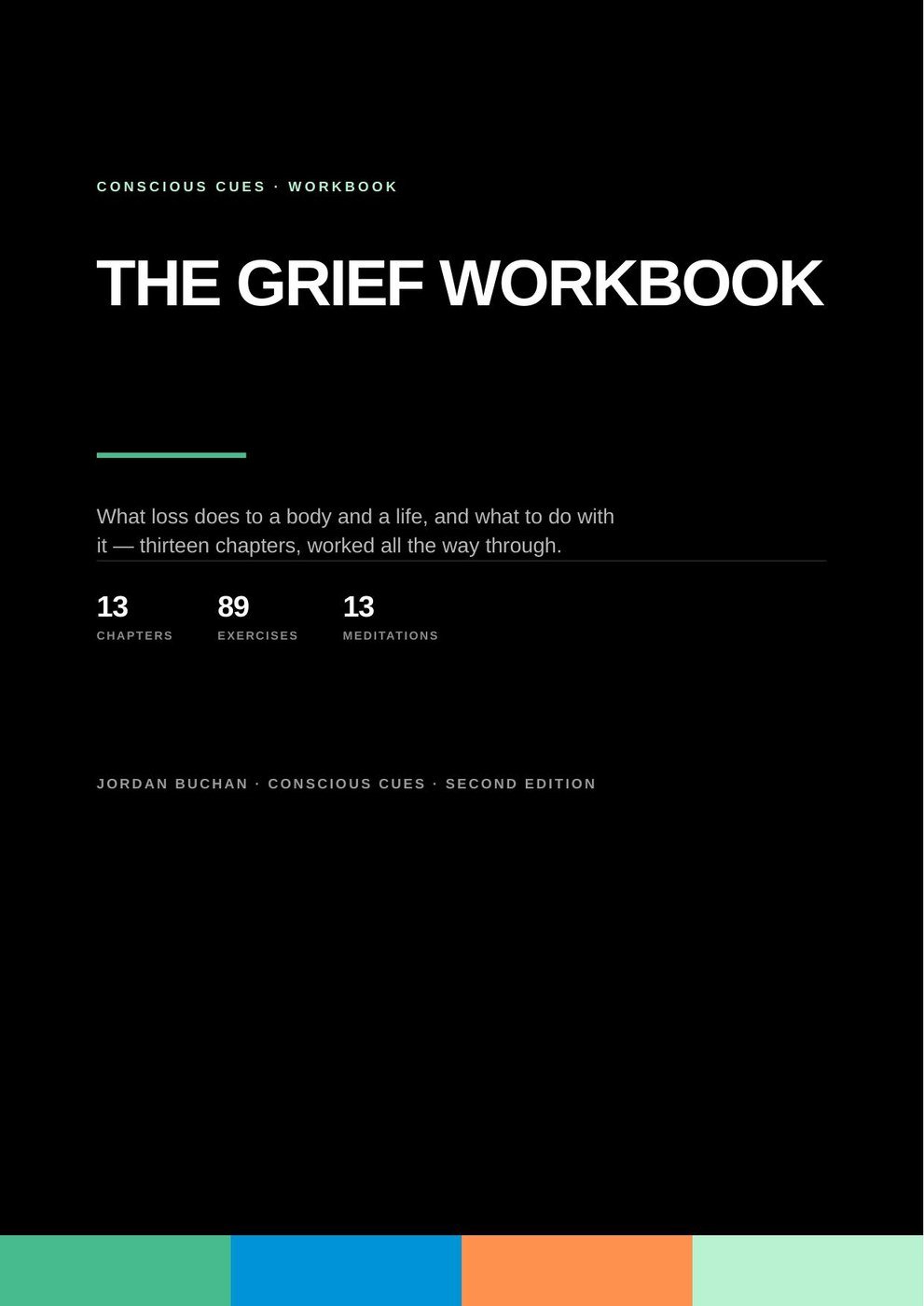
The Grief Workbook
A Conscious Cues Workbook

Grief is not a staircase.
This is the book that treats it that way.

Thirteen chapters, eighty-nine exercises you fill in with a pen, and a map on page five that asks what is loudest today and sends you straight to the page that deals with it. Including the page for when the answer is “nothing, and that frightens me”.

  • 89 exercises you fill in, not read
  • 13 guided meditations, written out line by line
  • A diagnostic chapter for symptoms you cannot explain
  • Eight tear-out cards for the supermarket and 3am
  • A fourteen-week plan you are allowed to fall behind on
Get the workbook — $49
One payment · yours forever

Instant access · Print it or work on screen · 30-day refund, no questions

Start here

You do not have to know where to start

Most grief books open at chapter one and assume you can read a book. In the first weeks you cannot, and two years in you do not need to — you need the four pages that are actually about your problem.

So page five is a router. Sixty sentences, grouped by what is loudest, each pointing at a real page number:

“I feel nothing at all, and that frightens me more than crying would” → p65
“I am relieved, and I cannot tell anyone that” → p51
“I cannot sleep, or I wake at the same time every night” → p64
“A song, a smell or a road takes me out every time” → p99
“It was a pet, a pregnancy, an ex, a friend, an estrangement” → p85
“Someone I love is grieving and I keep getting it wrong” → p153

You can use the whole book and never read it front to back. Plenty of people will.

The chapter most books do not have

What is underneath this

Grief almost never announces itself as grief. It announces itself as not eating, not sleeping, snapping at someone who did nothing, or a flat nothing where the sadness was supposed to be.

Chapter five takes each of those symptoms and lists what is commonly underneath it — because the handling is completely different. Not eating because meals were the thing you did together is a different problem from not eating because anxiety has shut your stomach down, which is different again from not eating because part of you is furious and has nowhere to put it.

Then it gives you a way to find out which one is yours. Most people working through it honestly find at least one thing they had not seen, and it is usually the thing that has been running the show.

What is in it

Thirteen chapters, in the order these things tend to arrive

01
Grief Is Not a Staircase
The five stages were about dying people, not bereaved ones. What actually happens instead.
02
Grief Lives in the Body
Sleep, appetite, the fog, the physical ache. A body map and a seven-day tracker.
03
The First Weeks
Triage. What can wait, what to hand over, and the exact sentences to have ready.
04
The Feelings Nobody Warns You About
Relief. Anger at them. Envy. Numbness. None of it means what you think it means.
05
What Is Underneath This
The diagnostic layer. Seven symptoms, what sits under each, and how to tell which is yours.
06
Grieving Before the Loss
For anyone watching someone go slowly, and carrying two secrets about it.
07
Grief Nobody Lets You Have
A pet, a pregnancy, an ex, an estrangement, someone still alive. Losses with no funeral.
08
Waves, Triggers and Anniversaries
Mapping what sets it off, and deciding the hard dates in advance on a calm day.
09
The Relationship Continues
Continuing bonds. There is no closure and you do not need one.
10
Growing Around It
The loss does not shrink. The life grows. What that actually looks like on a Tuesday.
11
Who You Lost Changes the Grief
A parent, partner, child, sibling, friend, pet, someone estranged, a death by suicide.
12
When the Person Grieving Is a Child
The words to use, the words to avoid, what they ask by age, and telling the school.
13
Being With Someone Who Is Grieving
What not to say, what works, and why support collapses exactly when it gets harder.

Then: twenty-one rituals for remembering and for putting something down, a section on being kinder to yourself, eight tear-out cards, ten groups of affirmations that are true on the bad days, and a fourteen-week plan with two rest weeks built in.

Every chapter, four ways

Neuroscience, psychology, the body, and how other cultures do it

Each chapter carries the same four lenses, each with a plain-terms box for the days when you cannot read carefully. The cultural lens is there because the English-speaking world kept the funeral and dropped almost everything after it, and most traditions that handle grief well do the opposite.

Where the book is summarizing someone else’s work — Stroebe and Schut on oscillation, Klass and Silverman on continuing bonds, Doka on disenfranchised grief, Boss on ambiguous loss, Tonkin on growing around it, Neff on self-compassion — it says whose work it is.

Honestly

Who this is not for

It will help if

  • You want something to do, with a pen, rather than something to read
  • Your grief does not fit the shape people expect of it
  • Nobody around you thinks your loss counts
  • You are years in and still get taken out by it
  • You are the one holding everyone else up

It will not help if

  • You want a book that promises stages, closure, or a timeline
  • You are in the first few days and cannot hold a pen — come back
  • You want someone to tell you it was meant to be
  • You need a therapist. This is not one, and it says so on page two
Before you buy it

What has not been reviewed

Nothing in this workbook has been clinically reviewed. It has not been read by a therapist, a grief specialist or a physician before publication. It is built from the research it cites, from work with people in the Conscious Cues community, and from reading well outside one person’s experience.

I would like that to change in a later edition. Until it does, this paragraph stays on the sales page as well as in the book.

Try it first

Twelve of the worksheets are free

If you want to know whether this way of working suits you before paying for it, take the free grief worksheets. Twelve printable pages drawn from the same book — the symptom map, the body map, the trigger map, the guilt audit, the letter and the ritual planner — plus two pocket cards. No payment, no trial.

Questions

Is this a book or a workbook?

A workbook. Roughly two thirds of it is space to write in. There is real reading — each chapter opens with what is actually going on and why it matters — but the point is the eighty-nine exercises, and a copy that stays pristine has not been used.

Do I have to start at the beginning?

No, and most people should not. Page five routes about sixty different states straight to the page that deals with them. The chapters are ordered roughly the way these things tend to arrive, not in an order you owe anybody.

Is it only for someone who has died?

No. Chapter six is for grief that starts before the death. Chapter seven is for losses that get no funeral at all — a pet, a pregnancy, an ex, an estrangement, someone who is still alive but gone. Those chapters exist because those losses are the ones people carry alone and for longest.

What if I am not the one grieving?

Chapter twelve is for when a child in your life is grieving, and chapter thirteen is for when an adult is and you want to be useful rather than well-meaning. They are not in the fourteen-week plan because they are not about your own grief; read them whenever they apply.

Can therapists and counselors use it with clients?

Yes, and people do. It is not a clinically validated instrument and should not be presented as one. Treat the exercises as structured prompts.

Print or screen?

Both. The PDF is A4 and print-ready, and there is an online version you can work in that saves as you go. Handwriting is better for this kind of work, so print the pages you are actually going to fill in.

What if it does not help?

Thirty days, refunded, no questions and no form to fill in. Grief is not a state in which you should have to argue with anybody about a refund.

The next hard date is on the calendar either way

Thirteen chapters, eighty-nine exercises, thirteen meditations, eight tear-out cards and the full guided online version. One payment. Yours forever, including everything added to it later.

Get the workbook — $49

Instant access · 30-day refund, no questions · No subscription

Already bought it

Unlock your download

Enter the email address you bought with. We will send a six-digit code, good for fifteen minutes.

Bought it and the code does not arrive? Check spam, then email hello@consciouscues.com and we will sort it out by hand.

03

Live Practice
Circles

The library and workshops give you the map. The Practice Circle is where you actually drive. This is a guided, real-time space to turn new behaviors into second nature.

Real-Time Prep Settle your nervous system so you can show up clearly and calmly.
Witnessed Practice Try out new ways of speaking and setting boundaries in low-pressure settings.
Stay Centered Learn how to keep your cool, even when a conversation gets intense.
Integration Bridge the gap between "the lab" and your real-world relationships.
Live Practice Agenda
90 MIN SESSION

Practice Session

1Somatic Grounding & Regulation
2Exercise Demo & Modeling
3Active Practice Breakout Rooms
4Sharing Circles & Peer Feedback
5Somatic Reflection & Integration
6Weekly "Homework" Assignment
7Closing Connection & Checkout

Safe Space Protocol Active

02

Skill-Building
Workshops

Before stepping into live practice, you get the technical tools. Our workshops provide the behavioral frameworks and internal blueprints required to navigate tough moments with confidence.

Behavioral Frameworks Move beyond theory with word-for-word scripts and structured communication blueprints.
Internal Safety Learn physical tools to manage your system so you can stay present during conflict.
Foundation Prep The core instruction that prepares you for real-world application in our Practice Circles.
Skill-Building Syllabus

Workshops

From Victim to Empowerment Breaking the cycle of feeling powerlessness
Live
Building Internal Safety Blueprints for remaining calm & focused
On-Demand
Stop Abandoning Yourself Breaking the people-pleasing mechanics
On-Demand
Conflict & Repair Word-for-word templates for connection
Live
01

Therapist-Backed
Resources

This is where your awareness begins. Everything in The Resource Center is neuroscience-informed and designed to help you gain the perspective needed to stop the spiral before it starts.

Deep-Dive Guides Comprehensive, exercise-rich walkthroughs on real-life challenges.
Somatic Practices Integrated body-based exercises to move theory into physical regulation.
Relational Scripts Word-for-word communication templates for boundaries and conflict.
Worksheets & PDFs Actionable downloads to work through specific challenges.
The Resource Center
TOOL
The Interactive Feelings Wheel Explore and work through your emotions
MP3
12-Min "Emergency Landing" Somatic Regulation Audio
GUIDE
Rewiring Negative Self-Talk Video Guide & Worksheet
PDF
High-Conflict Script Communication Template
ABOUT SOFIA

I am an Intern Somatic Body Psychotherapist, Neuroscientist, Dancer, and Dance Teacher. My passion for mental health began at age 14, sparked by a natural ability to attune to people’s emotional landscapes.

Over the past 15 years, I’ve travelled the world exploring the human psyche — a journey that shaped my integrated approach, rooted in neuroscience (brain), psychology (mind), philosophy (spirit), and somatic practices like dance (body).

This embedded with my empirical experience has made it a personal and interpersonal discovery – in line with my essence and natural tendency to help those around me deal with various aspects of mental well-being.

It is this multidimensional understanding of what it means to be human that is at the heart of my work.

My work as a somatic body psychotherapist draws on the concept that life is a continuous unfolding process, from the first cell in the womb to the present moment. All aspects of our being need to be considered when navigating mental health issues.

I support each client’s unique process with openness and curiosity of all these aspects, helping transform scattered energy into a coherent source of well-being and vitality, reshaping life in ways that often exceed expectations.

Through my Neuroscience of Dance project and Dance Integrated Healing Method, I offer neurocognitive and movement-based tools for healing.

For the past six years, I’ve supported dancers and educators worldwide through sessions and workshops, focusing on injury recovery, neurological rehabilitation, memory and balance, mental health, and the therapeutic potential of dance. This integration of dance, neuroscience, and psychology began during my postgraduate research on the brain mechanisms behind dance, in collaboration with a leading researcher in the field.

My research has been published in Dance Data, Cognition, and Multimodal Communication and presented at the International Association for Dance Medicine & Science (IADMS) conference. I was honoured when this project was nominated for the IADMS Dance Educator Award (2022) and the Applied Dance Science Award (2021) from One Dance UK, which also recognised me as a Healthier Dancer Practitioner.

Personally, advocate for neurodiversity as a proud dyslexic. I love cats, cute cafes, cats, long walks, writing, cats, poetry.

Did I say cats?

[gravityform id="1"]